Views: 5
In high-volume international polymer logistics, ocean freight charges, bunker adjustment factors (BAF), and inland drayage represent a substantial portion of the total landed cost of recycled Polyethylene Terephthalate (pet flakes). For global synthetic fiber spinning mills, thermoforming sheet extruders, and bottle-to-bottle preform manufacturers, freight optimization is directly tied to profitability.
When importing rPET feedstock across transatlantic and intercontinental maritime lanes, procurement teams evaluate three primary export packaging configurations: Compressed Bales, Heavy-Duty Octabins, and Flexible Intermediate Bulk Container (FIBC) Baffle Jumbo Bags.
Choosing an inefficient packaging format results in underutilized container volume, low payload weight per 40ft High Cube (HC) container, elevated freight rates per metric ton, and handling bottlenecks at plant discharge points.
This engineering and logistics guide provides a comparative analysis of baled, octabin, and jumbo bag shipping formats, calculates landed cost efficiencies, and demonstrates how Key Mart Limited optimizes payload density to reduce landed costs for international buyers.
1. Comparing Export Packaging Configurations: Bales vs. Octabins vs. Baffle Bags
Each packaging format interacts differently with container volume, bulk density, handling machinery, and material purity during ocean transit:
Packaging Selection ➔ Container Volume Utilization ➔ Payload Maximization (25–26 MT) ➔ Ocean Freight Optimization ➔ Automated Plant Intake
A. Compressed Bales
Shipping post-consumer PET as high-density compressed bales ($400\text{–}600\text{ kg/m}^3$) is common in scrap trading:
-
Logistics Payload: Maximizes gross container weight, easily reaching 25–27 MT per 40ft HC.
-
Operational Drawback: Bales consist of unwashed or roughly crushed scrap. They require intensive de-baling equipment, dry cleaning, sorting, and on-site washing at the destination plant, generating significant operational overhead, high contamination risks, and fiber-yield losses.
B. Heavy-Duty Corrugated Octabins
Octabins are eight-sided heavy-duty corrugated cardboard bulk containers set on wooden or composite pallets:
-
Handling Efficiency: Sturdy vertical sidewalls offer excellent stackability and allow direct integration with automatic vacuum suction probes.
-
Volume Inefficiency: Pallet bases and octagonal corner gaps create dead space inside a 40ft High Cube container. Maximum achievable payload is typically restricted to 18–21 Metric Tons, resulting in a 20%–25% freight cost penalty per ton of delivered rPET.
C. Form-Stable FIBC Baffle Jumbo Bags (The Industry Standard)
Baffle jumbo bags incorporate internal fabric panels sewn across the four corners. These internal baffles prevent the bag from rounding or bulging when filled with $8\text{–}12\text{ mm}$ flakes:
-
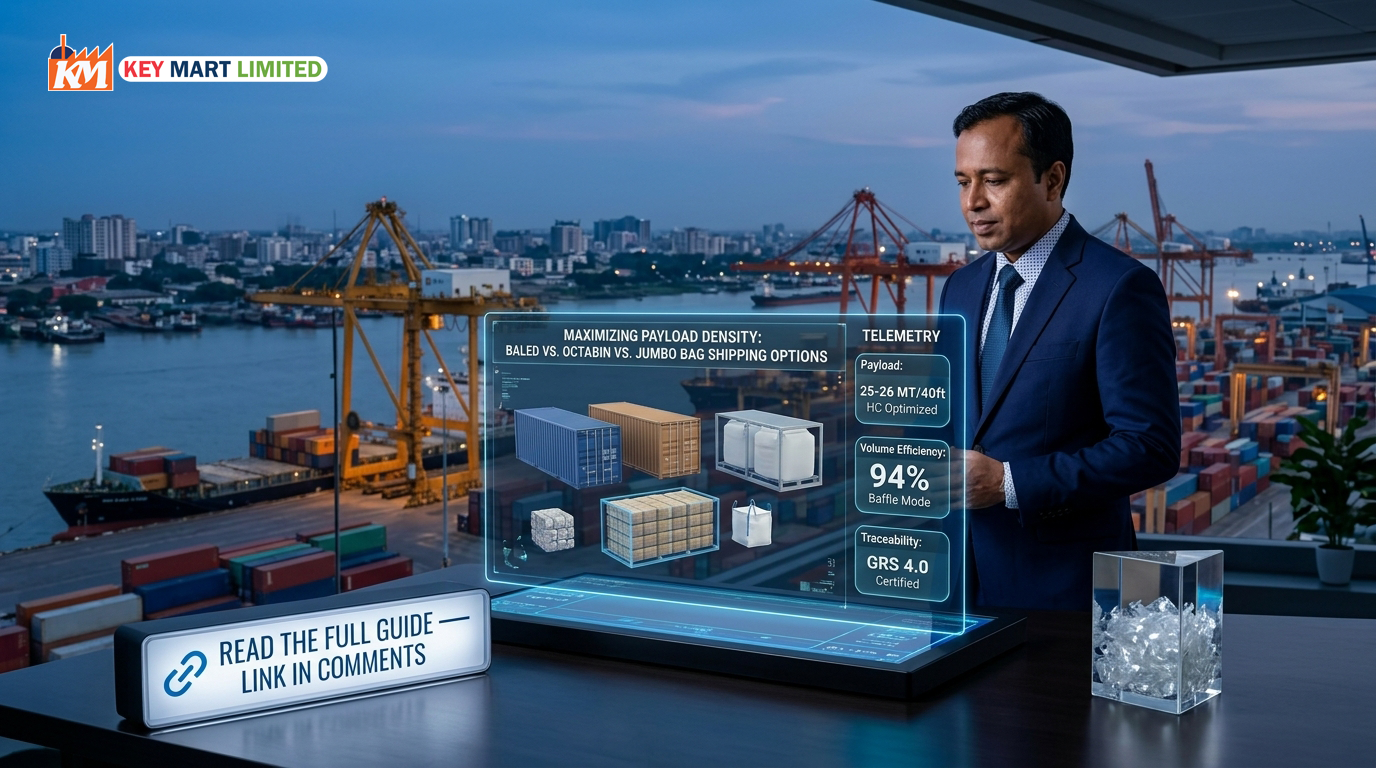
Optimized Payload: By maintaining a square profile, baffle bags eliminate dead space between bags and container walls, packing 25–26 Metric Tons into a standard 40ft High Cube container.
-
Direct Plant Intake: Equipped with top filling and bottom discharge spouts, baffle bags integrate smoothly into pneumatic conveying lines, gravimetric blenders, and modular bag-dump stations without requiring expensive de-baling lines.
Technical & Freight Optimization Comparison Table
| Operational & Logistics Metric | Compressed Bales | Corrugated Octabins | Form-Stable Baffle Jumbo Bags (Key Mart) |
| Payload per 40ft HC | $25.0\text{–}27.0\text{ MT}$ | $18.0\text{–}21.0\text{ MT}$ (Low Density) | 25.0 – 26.0 Metric Tons (Maximized) |
| Container Volume Utilization | $\approx 92\%$ | $\approx 72\%\text{–}78\%$ (Pallet Loss) | ≥ 94% (Zero Lateral Bulging) |
| Ocean Freight Cost per Ton | Lowest baseline | $+20\%\text{ to }+30\%$ Penalty | Optimized Lowest Landed Cost |
| Purity & Contamination | High scrap risk | Decontaminated flake | < 25 – 50 PPM PVC (Hot-Washed) |
| Moisture Protection | Zero barrier | Variable liner | 100-Micron PE Inner Moisture Barrier |
| Plant Handling Equipment | De-baler + Pre-washer required | Forklift + Suction probe | Direct bottom-spout hoist unloader |
| Traceability Audit | Difficult to trace | Standard documentation | GRS 4.0 Transaction Certified (TC) |
2. Preventing Transit Degradation with 100-Micron Barrier Liners
Achieving maximum payload density is only beneficial if material purity and dryness are preserved during maritime transit. During 30 to 50 days of ocean freight across variable climate zones, temperature swings generate condensation inside the container cavity.
Read More: A Step-by-Step Guide to Importing PET Flakes from Bangladesh via Chittagong Port
To protect high-density loads:
-
Virgin PE Moisture Barrier: Every baffle bag must be fitted with an integrated, heavy-duty 100-micron virgin polyethylene (PE) inner liner to prevent ambient humidity absorption.
-
Controlled Pre-Packing Moisture ($< 0.5\%$): Dewatering and hot-air drying ensure flakes are bagged at $< 0.5\%$ moisture, preventing hydrolytic chain scission in downstream extrusion.
-
De-Dusting ($< 0.3\%$ Fines): Removing fines and dust before packing increases bulk density and prevents material compaction and bridging during bottom-spout discharge.
3. How Key Mart Limited Optimizes Global rPET Supply Chains
Maximizing container payload while maintaining technical purity requires an established, export-oriented bangladesh pet flakes manufacturer with precision packing systems.
As a premier pet flakes company bangladesh and trusted pet flakes exporter, Key Mart Limited delivers maximized payloads and high-purity feedstock:
-
Engineered Baffle Packaging in Dhaka: Operating as a leading pet flakes manufacturer dhaka, Key Mart Limited packs materials into custom-engineered, form-stable Baffle FIBC Jumbo Bags (1,000–1,100 kg) fitted with 100-micron moisture-barrier liners, maximizing container volume utilization.
-
Guaranteed 25–26 MT Container Payloads: As an established bangladesh pet flakes manufacturer, our loading teams compact and square every container load, guaranteeing 25–26 Metric Tons per 40ft High Cube container to lower ocean freight overhead per ton under FOB Chittagong, CFR, or CIF shipping terms.
-
Continuous Hot-Caustic Decontamination: Our facility subjects post-consumer beverage bottles to multi-stage continuous hot-caustic washing ($85^\circ\text{C}-95^\circ\text{C}$) and automated NIR optical sorting, guaranteeing $\text{PVC} < 25\text{–}50\text{ PPM}$, zero glue residue, and moisture dried below $0.5\%$.
-
Full Chain-of-Custody GRS 4.0 Certification: Serving as an experienced pet flakes exporter, Key Mart Limited provides official Global Recycled Standard (GRS 4.0) Transaction Certificates (TCs) and batch-specific Certificates of Analysis (CoA) for every export shipment.
Partner with Key Mart Limited Today
Lower your ocean freight costs per ton, optimize plant discharge efficiency, and secure high-purity rPET flakes from Bangladesh. Contact our Dhaka export management team today to specify packaging dimensions, request Technical Data Sheets, or reserve monthly container allocations.
-
Company Name: Key Mart Limited
-
Head Office & Factory Address: Plot #31, Road #N-1, Block #K, Eastern Housing, Pallabi 2nd Phase, Rupnagar, Dhaka-1216, Bangladesh.
-
Official Website: www.keymartbd.com
-
Corporate Email: keymartltd@gmail.com | info@keymartbd.com
-
Direct Phone / WhatsApp: +8801760774499, +8801864935478
Join our community today and stay connected with the future of PET recycling.
 Visit our YouTube channel: Key Mart Limited on YouTube
Visit our Facebook Page: Key Mart Limited on Facebook
Subscribe to see our latest factory tours, production updates, and export success stories.