Views: 7
If you run a high-speed sheet line, spin POY/FDY yarns, or injection-mold bottle preforms, Intrinsic Viscosity ($IV$) is the heartbeat of your plant. It governs melt strength, parison stability, impact resistance, and tensile draw ratios. When working with post-consumer recycled Polyethylene Terephthalate (pet flakes), preserving that molecular chain length inside the extruder barrel is a constant engineering battle.
Every extrusion manager has experienced the dreaded drop: feedstock rated at $0.80\text{ dL/g}$ enters the hopper, but the molten polymer exiting the die registers at an unusable $0.66\text{ dL/g}$.
When $IV$ collapses, the symptoms are immediate: sagging sheets, brittle thermoforms, filament snaps at the spinneret, and surging melt pressures.
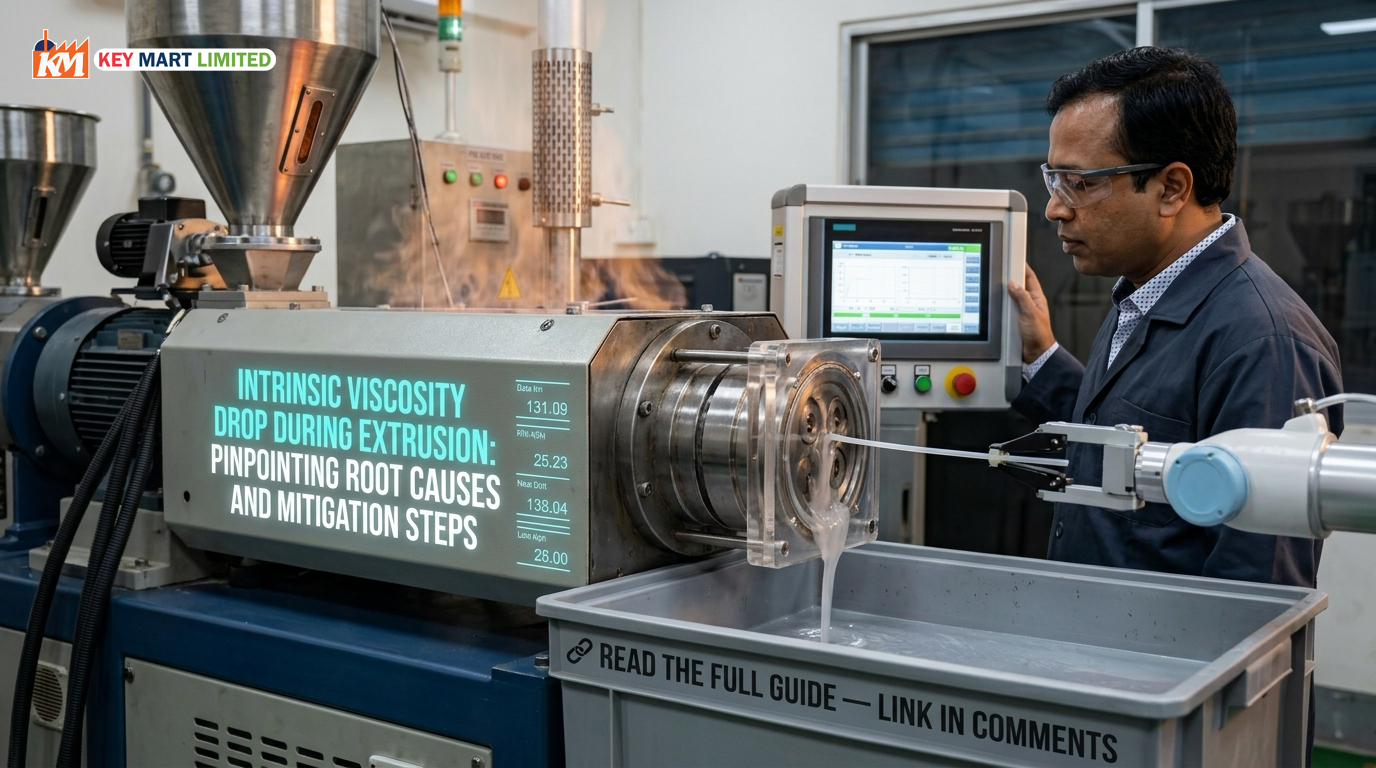
Solving this persistent problem requires mastering the mechanics behind IV drop in PET extrusion.
Uncontrolled $IV$ loss is not random—it stems from three root causes: hydrolytic degradation, thermal degradation, and mechanical shear scission.
Controlling incoming moisture ($< 30\text{–}50\text{ PPM}$), profiling screw shear rates, and dialing in barrel residence times ($< 3\text{–}5\text{ minutes}$) allows plant operators to cap total process $IV$ loss to under $0.02\text{–}0.04\text{ dL/g}$.
This technical troubleshooting guide analyzes the physics of chain scission, provides actionable machine parameters to preserve melt strength, and demonstrates how Key Mart Limited delivers low-moisture, high-IV rPET feedstock for consistent converting runs.
1. The Chemistry of IV Loss: Three Primary Degradation Pathways
Intrinsic Viscosity measures polymer molecular weight ($M_v$). As polymer chains break into shorter fragments, melt viscosity drops exponentially:
Raw Flake Feed ➔ Pre-Drying (<50 PPM H₂O) ➔ Controlled Shear Melting ➔ Vacuum Degassing (<10 mbar) ➔ Die Exit (ΔIV ≤ 0.03 dL/g) ➔ High-Tenacity End Product
A. Hydrolytic Degradation (Water-Induced Chain Cleavage)
Water is the fastest destroyer of PET polymer chains. At extrusion melt temperatures ($270^\circ\text{C}\text{–}290^\circ\text{C}$), even trace moisture reacts instantly with the ester linkages:
-
Moisture Threshold: For every $0.01\%$ ($100\text{ PPM}$) of residual water entering the barrel, $IV$ drops by roughly $0.03\text{–}0.05\text{ dL/g}$.
-
The Fix: Incoming flakes must undergo thorough desiccant drying (dew point $\le -40^\circ\text{C}$) or high-vacuum degassing ($< 10\text{ mbar}$) to bring moisture strictly below $30\text{ to }50\text{ PPM}$ before melting.
B. Thermal Degradation & Residence Time Overload
Holding molten PET at elevated temperatures ($> 285^\circ\text{C}$) without forward movement triggers random chain scission, generating vinyl ester end groups and volatile acetaldehyde (AA):
-
Barrel Residence Limits: Total molten residence time inside the barrel and melt-pipe manifold should never exceed $3\text{ to }5\text{ minutes}$.
-
Stagnant Dead Zones: Melt filtration housings and adapter manifolds must feature streamlined flow paths to prevent dead zones where resin cooks and degrades.
C. Mechanical Shear Scission
Aggressive screw designs with severe barrier flights or high-shear mixing blocks generate extreme local shear rates:
Excessive rotor speeds ($> 120\text{ RPM}$) on high-compression screws mechanically tear long-chain molecules apart, causing shear-induced heating that spikes melt temperatures $15^\circ\text{C}\text{–}25^\circ\text{C}$ above barrel setpoints.
Read More: A Step-by-Step Guide to Importing PET Flakes from Bangladesh via Chittagong Port
Extrusion Process Parameters & IV Retention Benchmark
| Process Parameter | Uncontrolled Scrap Line | Standard rPET Extrusion Line | Optimized Line (Key Mart Base Standard) |
| Incoming Flake Intrinsic Viscosity | $0.68\text{–}0.72\text{ dL/g}$ | $0.74\text{–}0.76\text{ dL/g}$ | 0.78 – 0.82 dL/g (Stable Baseline) |
| Pre-Extrusion Moisture Level | $> 250\text{ PPM}$ ($> 0.025\%$) | $80\text{–}150\text{ PPM}$ | < 30 – 50 PPM (Desiccant/Infrared Dried) |
| Melt Temperature at Die Head | $> 295^\circ\text{C}$ (Overheated) | $285^\circ\text{C}\text{–}290^\circ\text{C}$ | 275°C – 282°C (Controlled Melt) |
| Barrel Residence Time | $> 8\text{ Minutes}$ | $4\text{–}6\text{ Minutes}$ | < 3.5 Minutes (Fast Swept Volume) |
| Vacuum Degassing Level | Unvented / Atmospheric | $30\text{–}50\text{ mbar}$ | < 5 – 10 mbar (Deep Vacuum Extraction) |
| Total Extrusion IV Drop ($\Delta IV$) | $> 0.12\text{–}0.18\text{ dL/g}$ | $0.06\text{–}0.08\text{ dL/g}$ | ≤ 0.02 – 0.04 dL/g (Maximum Retention) |
| Dust & Fines Content ($<500\,\mu\text{m}$) | $> 2.5\text{–}3.5\%$ | $1.0\text{–}1.5\%$ | < 0.3% (Multi-Stage Air Elutriated) |
| PVC Contamination Ceiling | $> 150\text{–}300\text{ PPM}$ | $50\text{–}100\text{ PPM}$ | < 25 – 50 PPM (Continuous Hot-Caustic) |
2. Practical Mitigation: Machine Adjustments for Plant Managers
Preserving melt strength across demanding converting runs requires three primary operational adjustments:
-
Optimize Barrel Temperature Profiles: Program a “reverse” or “flat” temperature gradient (e.g., $265^\circ\text{C}$ at the feed zone, $275^\circ\text{C}$ in the metering zone, and $280^\circ\text{C}$ at the die). This melts the polymer efficiently while avoiding thermal hot-spots.
-
Eliminate Fines from the Feedstock: Micro-fines ($< 500\,\mu\text{m}$) melt instantly in the feed throat, forming an insulating liquid film that induces screw slippage, uneven shear, and localized thermal charring. Sourcing air-elutriated feedstock with sub-0.3% fines ensures smooth solid-bed transport.
-
Calibrate Melt Pump (Gear Pump) Speed: Running an inline gear pump stabilizes pressure at the die while decoupling the extruder screw from backpressure, allowing you to lower screw RPM and minimize shear heating.
3. How Key Mart Limited Supplies High-IV, Chemically Pristine rPET Flakes
Maintaining tight $IV$ tolerances on your production floor starts with sourcing from an established bangladesh pet flakes manufacturer that prioritizes high-temperature washing, strict sorting, and moisture control.
As a premier pet flakes company bangladesh and trusted pet flakes exporter, Key Mart Limited supplies high-clarity rPET flakes engineered to minimize extrusion $IV$ loss:
-
Source-Segregated Dhaka Collection: Operating as a leading pet flakes manufacturer dhaka, Key Mart Limited selectively processes 100% post-consumer clear beverage bottles, rejecting degraded scrap, multi-layer barriers, and contaminated post-industrial plastics at our intake gates.
-
Continuous Hot-Caustic Washing ($85^\circ\text{C}-95^\circ\text{C}$): As an established bangladesh pet flakes manufacturer, our facility subjects flakes to continuous hot-caustic friction washing and automated NIR optical sorting, fully saponifying label glues and stripping organic residues to guarantee $\text{PVC} < 25\text{–}50\text{ PPM}$ and zero glue carryover.
-
Intensive Heat-Drying to Lock Moisture Below 0.5%: Flakes undergo dynamic centrifugal dewatering and secondary hot-air drying to guarantee moisture levels strictly below 0.5% before packing, preventing hydrolytic degradation during ocean transport.
-
Sub-0.3% Fines Removal via Air Elutriation: Serving as an experienced pet flakes exporter, Key Mart Limited passes every batch through automated multi-stage zig-zag air classifiers, keeping dust and fines strictly below $0.3\%$ to eliminate feed throat bridging and melt instability.
-
Tight IV Stability & Batch-Specific Lab Testing: Every export shipment is verified in our Dhaka quality control laboratory for stable Intrinsic Viscosity ($0.78\text{–}0.82\text{ dL/g}$ with $\pm 0.02$ batch consistency) and high optical clarity ($L^* \ge 74.0, b^* \le +1.2$), backed by batch-specific Certificates of Analysis (CoA) and Global Recycled Standard (GRS 4.0) Transaction Certificates (TC).
-
Maximized 25–26 MT Container Logistics: We pack 25–26 Metric Tons into every 40ft High Cube container with heavy-duty 100-micron PE inner liners to preserve feedstock dryness during transit under FOB Chittagong, CFR, or CIF shipping terms.
Partner with Key Mart Limited Today
Eliminate extrusion line stoppages, maintain melt strength, and secure high-IV, low-contaminant rPET flakes from Bangladesh. Contact our Dhaka export management team today to request Technical Data Sheets, order commercial testing samples, or reserve monthly container allocations.
-
Company Name: Key Mart Limited
-
Head Office & Factory Address: Plot #31, Road #N-1, Block #K, Eastern Housing, Pallabi 2nd Phase, Rupnagar, Dhaka-1216, Bangladesh.
-
Official Website: www.keymartbd.com
-
Corporate Email: keymartltd@gmail.com | info@keymartbd.com
-
Direct Phone / WhatsApp: +8801760774499, +8801864935478
Join our community today and stay connected with the future of PET recycling.
 Visit our YouTube channel: Key Mart Limited on YouTube
Visit our Facebook Page: Key Mart Limited on Facebook
Subscribe to see our latest factory tours, production updates, and export success stories.