Views: 7
In the manufacturing of high-clarity APET thermoforming sheets, bottle-to-bottle preforms, and high-tenacity textile filaments, color consistency is the primary visual benchmark of recycled polymer quality. When converting post-consumer recycled Polyethylene Terephthalate (pet flakes), processing plants frequently struggle with batch-to-batch visual variance: unwanted yellow shifts, graying, and optical haze.
Inconsistent feedstock color causes preform haze, visible tint variation in clear packaging, and expensive masterbatch tonal correction adjustments.
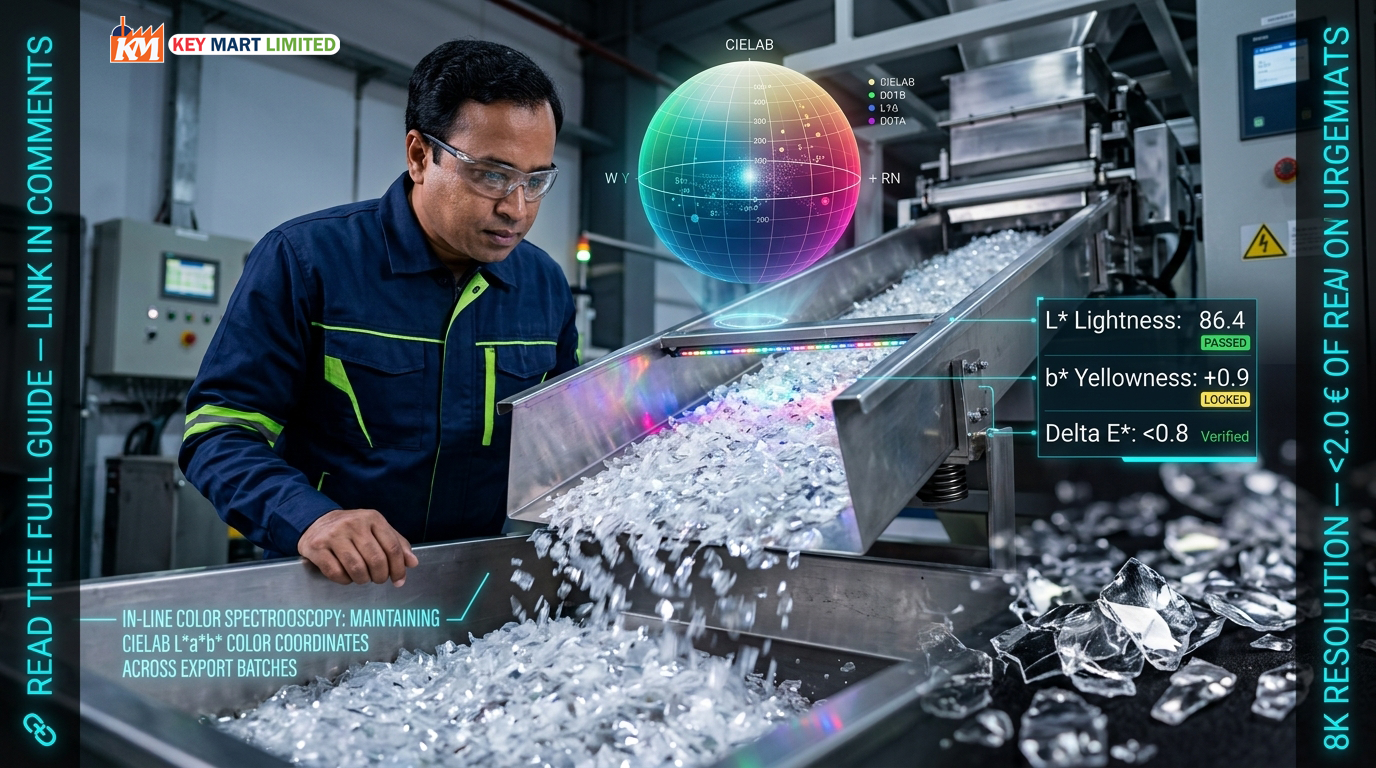
Eliminating these optical variations requires transitioning away from manual grab-sampling toward continuous PET flake CIELAB color measurement using in-line spectrophotometry.
Deploying high-speed spectrophotometric inspection guarantees that every export container maintains high lightness ($L^* > 85.0$) and minimal yellowness ($b^* < 1.5$), providing international converters with consistent optical clarity.
This technical engineering guide examines the mechanics of spectrophotometric color measurement, establishes CIELAB standard windows, and demonstrates how Key Mart Limited delivers low-contaminant, color-consistent rPET feedstock to global packaging converters.
1. Principles of CIELAB Color Spectroscopy in rPET Sorting
The CIE $L^*a^*b^*$ color space (defined by the International Commission on Illumination) quantifies optical properties across three Cartesian coordinates under a standard illuminant ($D65$, $10^\circ$ observer):
Raw Flake Stream ➔ In-Line Xenon/LED Flash Illumination ➔ Spectral Reflectance Capture (380–780 nm) ➔ CIELAB Computation (L*, a*, b*) ➔ High-Speed Optical Ejection (ΔE* < 1.0)
A. The Three Axes of Recycled PET Color Metrics
-
$L^*$ (Lightness / Luminance): Ranges from $0$ (pure black) to $100$ (diffuse white). Unwashed scrap flakes typically measure $L^* < 68.0$ due to surface dust, micro-soot, and thermal degradation. Optical-grade clear bottle flakes must achieve $L^ \ge 82.0\text{–}86.0$* to match virgin resin transparency.
-
$a^*$ (Red-Green Axis): Negative values represent green, while positive values represent red. Residual green bottle flakes shift $a^*$ negatively ($a^* < -2.0$). Target clear rPET maintains $-0.5 \le a^ \le +0.5$*.
-
$b^*$ (Yellow-Blue Axis): Negative values represent blue, while positive values indicate yellow. Thermal degradation, PVC cross-linking, and residual label glue cause a sharp positive yellow shift ($b^* > +3.5$). High-clarity rPET requires $b^ \le +0.8\text{–}+1.5$*.
B. Total Color Difference Formula ($\Delta E^*$)
To ensure uniform color between separate export containers, quality control algorithms evaluate the Euclidean distance between sample lots:
Maintaining $\Delta E^ < 1.2$* across multi-ton production runs guarantees that thermoformed sheet manufacturers will experience zero noticeable color variation under retail lighting.
Read More: A Step-by-Step Guide to Importing PET Flakes from Bangladesh via Chittagong Port
CIELAB Color Quality & Processing Parameter Benchmark
| Optical & Physical Metric | Standard Scrap Flakes (High Variation) | Intermediate Washed Flakes | Optical Export Standard (Key Mart Standard) |
| Lightness ($L^*$ Coordinate) | $62.0\text{–}68.0$ (Gray / Dull) | $72.0\text{–}76.0$ (Moderate Clarity) | 84.0 – 87.0+ (High Optical Transparency) |
| Yellowness ($b^*$ Coordinate) | $> +3.5\text{–}+6.0$ (Severe Yellow) | $+2.0\text{–}+3.0$ (Slight Yellow) | +0.5 – +1.4 (Neutral Crystal Clear) |
| Red/Green ($a^*$ Coordinate) | $-2.5\text{–}-4.0$ (Green Tint) | $-1.0\text{–}-1.5$ | -0.5 to +0.5 (True Neutral Balance) |
| Total Color Variance ($\Delta E^*$) | $> 3.5$ (Visible Discrepancy) | $1.8\text{–}2.5$ | < 1.0 – 1.2 (Imperceptible Variation) |
| PVC Contamination | $> 150\text{–}300\text{ PPM}$ | $50\text{–}100\text{ PPM}$ | < 25 – 50 PPM (Continuous Hot-Caustic) |
| Dust & Fines Content ($<500\,\mu\text{m}$) | $> 2.5\text{–}4.0\%$ | $1.0\text{–}1.5\%$ | < 0.3% (Multi-Stage Air Elutriated) |
| Supply Traceability | Unverified | Self-Declared | GRS 4.0 Transaction Certified (TC) |
2. In-Line Spectroscopic Integration and Optical Sorting Controls
Maintaining color uniformity across high-volume production requires integrating real-time spectroscopy into the washing and flake sorting line:
-
High-Speed In-Line Optical Sensors: Multi-channel CCD line-scan spectrophotometers measure the spectral reflectance ($380\text{–}780\text{ nm}$) of flakes moving across high-speed vibrating chutes at velocities up to $3.0\text{ m/s}$.
-
Pneumatic Rejection of Off-Color Particles: When individual flakes deviate beyond preset CIELAB thresholds ($b^* > +2.0$ or $a^* < -1.0$), high-frequency pneumatic air valves eject off-spec particles within milliseconds.
-
Continuous Hot-Caustic Washing ($85^\circ\text{C}-95^\circ\text{C}$): Saponifying adhesive residues and stripping surface micro-contaminants eliminates organic compounds that would otherwise carbonize and yellow during downstream extrusion.
3. How Key Mart Limited Supplies Color-Consistent rPET Feedstock Globally
Guaranteeing consistent CIELAB color parameters across export lots requires an established bangladesh pet flakes manufacturer equipped with optical sorting systems and laboratory verification.
As a premier pet flakes company bangladesh and trusted pet flakes exporter, Key Mart Limited delivers optically stable, low-contaminant rPET flakes to global convertors:
-
Source-Segregated Clear Bottle Intake in Dhaka: Operating as a leading pet flakes manufacturer dhaka, Key Mart Limited selectively processes 100% post-consumer clear beverage bottles, excluding tinted plastics, opaque containers, and degraded scrap at our collection centers.
-
Continuous Multi-Stage Caustic Washing: As an established bangladesh pet flakes manufacturer, our facility subjects flakes to continuous hot-caustic friction washing ($85^\circ\text{C}-95^\circ\text{C}$) and automated NIR optical sorting, guaranteeing $\text{PVC} < 25\text{–}50\text{ PPM}$, zero adhesive residue, and moisture dried below 0.5%.
-
Sub-0.3% Fines Removal via Air Elutriation: Serving as an experienced pet flakes exporter, Key Mart Limited passes every batch through automated multi-stage zig-zag air classifiers, keeping dust and fines strictly below $0.3\%$ to eliminate graying caused by burnt fines in the extruder.
-
Batch-Specific Spectrophotometric Verification: Every export lot is tested in our Dhaka quality control laboratory using calibrated benchtop spectrophotometers to confirm $L^* \ge 84.0$, $b^* \le +1.4$, and stable Intrinsic Viscosity ($0.78\text{–}0.82\text{ dL/g}$), backed by batch-specific Certificates of Analysis (CoA) and Global Recycled Standard (GRS 4.0) Transaction Certificates (TC).
-
Maximized 25–26 MT Container Logistics: We pack 25–26 Metric Tons into every 40ft High Cube container with heavy-duty 100-micron PE inner liners to preserve feedstock dryness during transit under FOB Chittagong, CFR, or CIF shipping terms.
Partner with Key Mart Limited Today
Eliminate yellow shifts, stabilize your optical thermoforming lines, and secure color-consistent rPET flakes from Bangladesh. Contact our Dhaka export management team today to request Technical Data Sheets, order commercial trial samples, or reserve monthly container allocations.
-
Company Name: Key Mart Limited
-
Head Office & Factory Address: Plot #31, Road #N-1, Block #K, Eastern Housing, Pallabi 2nd Phase, Rupnagar, Dhaka-1216, Bangladesh.
-
Official Website: www.keymartbd.com
-
Corporate Email: keymartltd@gmail.com | info@keymartbd.com
-
Direct Phone / WhatsApp: +8801760774499, +8801864935478
oin our community today and stay connected with the future of PET recycling.
 Visit our YouTube channel: Key Mart Limited on YouTube
Visit our Facebook Page: Key Mart Limited on Facebook
Subscribe to see our latest factory tours, production updates, and export success stories