Views: 6
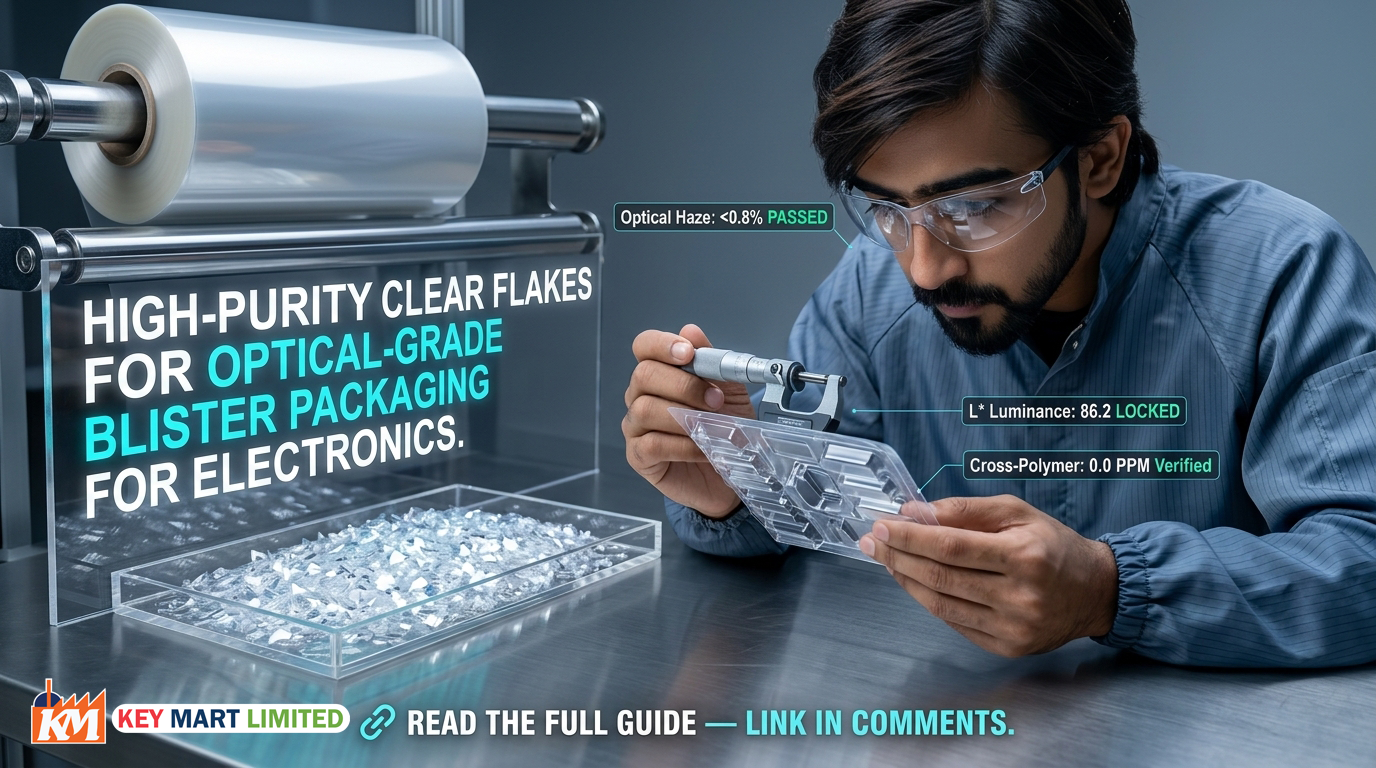
In retail electronics packaging, visual presentation directly impacts product value. Premium consumer electronics—such as smartphones, wireless earbuds, smartwatches, and precision hardware—rely on transparent thermoformed blister packaging to highlight product aesthetics on retail shelves.
Historically, thermoformers relied exclusively on virgin amorphous PET (APET) to achieve crystal clarity.
However, as global consumer brands commit to 30% to 50% post-consumer recycled content in secondary packaging, sheet extruders face a major processing challenge: optical haze, un-melted gels, and yellow discoloration.
When consumers evaluate high-end electronics, packaging with cloudy haze, black specks, or wavy gel streaks diminishes perceived quality.
Transitioning to sustainable blister displays without sacrificing optical clarity requires sourcing premium optical grade rPET packaging sheet feedstock.
Achieving low haze values ($< 1.0\%$), high luminance ($L^* > 85.0$), and zero surface streaks requires strict control over raw material contaminants, fine melt filtration, and minimal thermal degradation during processing.
This engineering guide examines the causes of optical defects in rPET sheet extrusion, outlines key quality parameters, and demonstrates how Key Mart Limited supplies ultra-clean, optical-grade rPET flakes to packaging converters worldwide.
1. The Physics of Transparency: Eliminating Haze and Gel Streaks
Achieving optical-grade transparency in extruded APET sheet ($200\text{–}800\,\mu\text{m}$) requires strict control over polymer morphology and contaminant levels:
Clear Bottle Flake Feed ➔ Low-Heat Desiccant Drying (<30 PPM Moisture) ➔ Fine Melt Filtration (25–40 µm) ➔ Flat Die Extrusion ➔ High-Polish Chill Roll Quench ➔ Crystal-Clear Blister Sheet
A. Root Causes of Optical Haze and Cloudiness
-
Cross-Polymer Phase Separation: Incompatible polymers like Polypropylene (PP) or Polyethylene (PE) from bottle caps do not dissolve in molten PET. Even $50\text{ PPM}$ of polyolefin residue forms microscopic dispersed droplets that scatter light, creating cloudy haze.
-
Thermal Degradation & Charring: Residual label glues (EVA/acrylic) and organic starches decompose inside the extruder barrel at $280^\circ\text{C}$, producing tiny black specks and shifting the CIELAB $b^*$ coordinate toward an unwanted yellow tint.
-
Hydrolytic IV Loss: Processing damp flakes causes hydrolytic degradation, lowering Intrinsic Viscosity ($IV$) and leading to uneven sheet thickness and poor thermoforming draw ratios.
B. Un-Melted Gels and Die Lip Drag Lines
Cross-linked polymer gels, highly crystalline particulate, or microscopic PVC fragments create fish-eyes and wavy surface streaks as melt exits the flat die lips. High-clarity electronics packaging requires continuous multi-stage screen changers with $25\text{ to }40\,\mu\text{m}$ filtration to capture particulate before the sheet cast rolls.
Read More: A Step-by-Step Guide to Importing PET Flakes from Bangladesh via Chittagong Port
Optical-Grade Packaging Sheet Performance Benchmark
| Optical & Physical Parameter | Standard Utility-Grade rPET | Intermediate Thermoforming Flakes | Optical-Grade Standard (Key Mart) |
| Optical Haze (%) | $> 3.5\text{–}5.0\%$ (Visible Haze) | $1.5\text{–}2.5\%$ | < 0.8% – 1.0% (Crystal Clear) |
| Lightness ($L^*$ Coordinate) | $68.0\text{–}74.0$ (Dull/Dark) | $76.0\text{–}80.0$ | 84.0 – 87.0+ (High Transparency) |
| Yellowness ($b^*$ Coordinate) | $> +3.5\text{–}+5.0$ (Yellow Shift) | $+2.0\text{–}+2.8$ | +0.5 – +1.2 (Neutral Clear) |
| PVC Contamination Ceiling | $> 150\text{–}300\text{ PPM}$ | $50\text{–}100\text{ PPM}$ | < 25 – 50 PPM (Continuous Hot-Caustic) |
| Polyolefin Content (PP/PE) | $> 200\text{ PPM}$ | $50\text{–}100\text{ PPM}$ | < 25 PPM (Zero Haze Domains) |
| Dust & Fines Content ($<500\,\mu\text{m}$) | $> 2.5\text{–}3.5\%$ | $1.0\text{–}1.5\%$ | < 0.3% (Multi-Stage Air Elutriated) |
| Intrinsic Viscosity (IV) Baseline | $0.65\text{–}0.70\text{ dL/g}$ | $0.72\text{–}0.74\text{ dL/g}$ | 0.78 – 0.82 dL/g (Stable Baseline) |
| Chain-of-Custody Certification | Unverified | Self-Declared | GRS 4.0 Transaction Certified (TC) |
2. Best Practices for Thermoforming Blister Packaging
Converting high-purity pet flakes into flawless transparent clamshells and thermoformed trays requires three primary production controls:
-
Rapid Chill Roll Quenching: Extruded sheet must pass across mirror-polished, chrome-plated chill rolls ($20^\circ\text{C}\text{–}30^\circ\text{C}$) immediately upon exiting the die. Rapid quenching freezes the polymer in an amorphous state ($X_c < 5\%$), preventing secondary crystallization that causes milky haze.
-
Even Heating in Thermoforming Ovens: Amorphous APET sheets soften evenly between $120^\circ\text{C}$ and $140^\circ\text{C}$. Starting with consistent-IV feedstock prevents localized sheet sagging and web thinning during vacuum forming.
-
Moisture dried below 0.5% at Sealing: Pre-drying flakes to sub-50 PPM moisture in desiccant or infrared dryers prevents bubble formation and hydrolytic degradation inside the extruder barrel.
3. How Key Mart Limited Supplies Optical-Grade rPET Flakes
Producing defect-free, optical-grade blister packaging requires partnering with an established bangladesh pet flakes manufacturer that enforces rigorous raw material selection, hot-caustic decontamination, and automated sorting.
As a premier pet flakes company bangladesh and trusted pet flakes exporter, Key Mart Limited delivers low-contaminant, high-clarity rPET flakes engineered specifically for sheet extrusion lines:
-
Source-Segregated Clear Bottle Intake in Dhaka: Operating as a leading pet flakes manufacturer dhaka, Key Mart Limited selectively processes 100% post-consumer clear beverage containers, rejecting tinted scrap, opaque bottles, and non-food packaging at the collection stage.
-
Continuous Multi-Stage Caustic Washing ($85^\circ\text{C}-95^\circ\text{C}$): As an established bangladesh pet flakes manufacturer, our facility subjects flakes to continuous hot-caustic friction washing and automated NIR optical sorting, fully saponifying label glues and stripping organic residues to guarantee $\text{PVC} < 25\text{–}50\text{ PPM}$ and zero glue carryover.
-
Sub-0.3% Fines Removal via Air Elutriation: Serving as an experienced pet flakes exporter, Key Mart Limited passes every batch through automated multi-stage zig-zag air classifiers, keeping dust and fines strictly below $0.3\%$ to eliminate premature burning and black specks in the melt.
-
Consistent IV and Batch Traceability: Every export batch is tested in our Dhaka quality control laboratory for stable Intrinsic Viscosity ($0.78\text{–}0.82\text{ dL/g}$) and high luminance ($L^* \ge 84.0, b^* \le +1.2$), backed by batch-specific Certificates of Analysis (CoA) and Global Recycled Standard (GRS 4.0) Transaction Certificates (TC).
-
Maximized 25–26 MT Container Logistics: We pack 25–26 Metric Tons into every 40ft High Cube container with heavy-duty 100-micron PE inner liners to preserve feedstock dryness during transit under FOB Chittagong, CFR, or CIF shipping terms.
Partner with Key Mart Limited Today
Eliminate optical haze, prevent gel streaks in clear blister packaging, and secure high-purity rPET flakes from Bangladesh. Contact our Dhaka export management team today to request Technical Data Sheets, order commercial testing samples, or reserve monthly container allocations.
-
Company Name: Key Mart Limited
-
Head Office & Factory Address: Plot #31, Road #N-1, Block #K, Eastern Housing, Pallabi 2nd Phase, Rupnagar, Dhaka-1216, Bangladesh.
-
Official Website: www.keymartbd.com
-
Corporate Email: keymartltd@gmail.com | info@keymartbd.com
-
Direct Phone / WhatsApp: +8801760774499, +8801864935478
Join our community today and stay connected with the future of PET recycling.
 Visit our YouTube channel: Key Mart Limited on YouTube
Visit our Facebook Page: Key Mart Limited on Facebook
Subscribe to see our latest factory tours, production updates, and export success stories.