Views: 19
As brand owners and food packaging manufacturers accelerate the transition toward circular packaging, incorporating post-consumer recycled Polyethylene Terephthalate (pet flakes) into food-contact applications—such as beverage bottles, thermoformed fruit punnets, and food trays—has become an industry standard.
However, introducing recycled polymers into direct food contact requires navigating strict global food safety regulations.
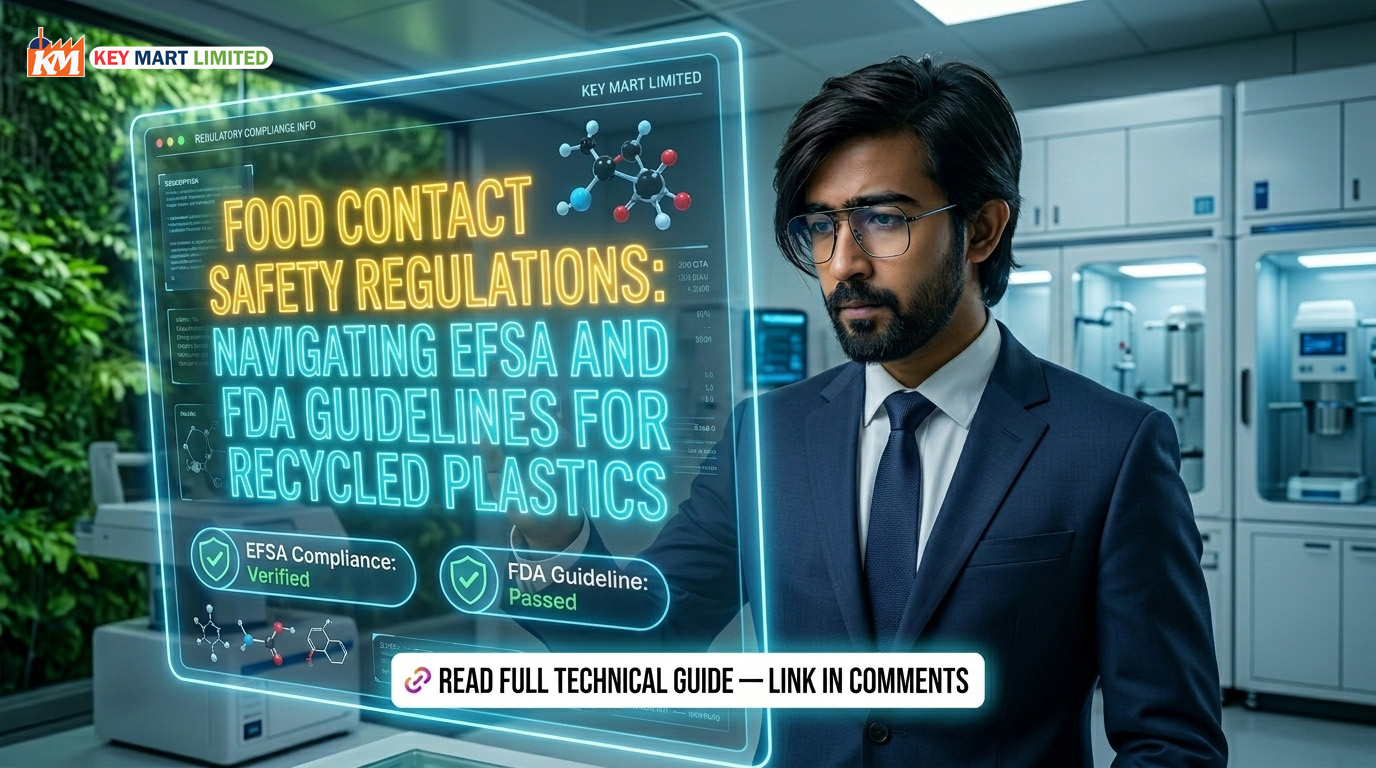
Regulatory bodies like the European Food Safety Authority (EFSA) and the U.S. Food and Drug Administration (FDA) enforce rigorous toxicological standards to guarantee that recycled plastics do not migrate harmful chemical contaminants into food products.
This comprehensive regulatory and technical guide breaks down the core safety frameworks established by EFSA and the FDA, details the challenge of chemical migration, and explains how high-purity washing and decontamination enable food-safe rPET packaging.
1. Regulatory Frameworks: EFSA vs. FDA for Recycled Plastics
While both European and American regulatory bodies aim to eliminate chemical contamination risks in food-contact materials, their evaluation methodologies and approval pathways differ:
Post-Consumer Bottle Sourcing ➔ Sorting & De-labeling ➔ Hot Caustic Washing ➔ Challenge Test Verification ➔ EFSA / FDA Compliance
A. EFSA Guidelines (EU Regulation 2022/1616)
Under European Union Regulation (EU) 2022/1616 on recycled plastic materials intended to come into contact with foods, EFSA mandates that recycling processes undergo rigorous risk assessments.
-
Core Focus: EFSA focuses heavily on input feedstock control and the decontamination capability of the recycling technology.
-
Challenge Testing: Recycling processes must demonstrate through “Challenge Tests” that the technology can remove surrogate chemical contaminants (representing volatile and non-volatile organic compounds) down to non-detectable migration limits ($< 0.01\,\mu\text{g/kg}$ in food).
-
Origin Control: Input bottle streams must originate strictly from food-contact post-consumer collection loops (minimum 95% food-contact PET bottles).
B. FDA Guidelines (21 CFR & LNO Letters)
The U.S. FDA regulates recycled plastics under its Food Contact Notification (FCN) framework and issues Letters of No Objection (LNO).
-
Physical vs. Chemical Decontamination: The FDA evaluates whether mechanical recycling processes (washing, drying, and thermal decontamination) sufficiently clean the recycled plastic so that residual contaminants do not migrate into food under intended conditions of use.
-
Use Conditions: FDA LNO approvals specify operational limitations, ranging from Condition of Use A (high-temperature heat sterilization) down to Condition of Use H (frozen storage).
Read More: A Step-by-Step Guide to Importing PET Flakes from Bangladesh via Chittagong Port
Technical Food-Contact Compliance Benchmark Table
| Regulatory & Safety Parameter | Non-Food Grade Industrial Feedstock | Food-Contact Grade rPET Benchmark | Technical Impact on Packaging |
| PVC Contamination | $< 150 \text{ PPM}$ | < 10 – 25 PPM |
Prevents acid formation, black specks, and toxic degradation |
| Polyolefin (Cap & Label) | $< 200 \text{ PPM}$ | < 25 PPM |
Eliminates migration voids, pinholes, and optical haze |
| Limiting Migration Limit (LML) | Not required | < 0.01 mg/kg in food matrix |
Guarantees toxicological safety per EFSA/FDA rules |
| Input Source Control | Mixed post-consumer | ≥ 95% Food-Grade Post-Consumer Bottles |
Complies with EU 2022/1616 input stream mandates |
| Moisture Content | $< 0.5\%$ | < 0.3% |
Eliminates hydrolytic chain scission during sheet extrusion |
2. Preventing Chemical Migration in Post-Consumer PET Flakes
The primary safety threat in recycled PET packaging is the migration of volatile organic compounds (VOCs), residual adhesives, or non-food chemicals absorbed during consumer usage.
Preventing migration requires a multi-stage decontamination strategy:
-
Strict Input Feedstock Classification: Separating non-food PET bottles (detergents, cosmetics, agrochemicals) at the collection stage to ensure input feedstock meets the 95% food-contact threshold.
-
High-Temperature Hot-Caustic Washing: Removing surface adhesives, paper labels, and printing inks through continuous hot caustic ($85^\circ\text{C}-95^\circ\text{C}$) friction washing.
-
Advanced NIR & Optical Sorter Defect Removal: Utilizing high-resolution Near-Infrared (NIR) optical sorters to eject PVC, non-PET polymers, and discolored flakes down to sub-25 PPM levels.
3. How Key Mart Limited Fulfills Global Buyer Demand for Food-Safe Feedstock
Meeting EFSA and FDA food-contact standards requires an experienced raw material exporter capable of strictly controlling feedstock purity from collection to container loading.
As a premier pet flakes company bangladesh and trusted pet flakes exporter, Key Mart Limited supplies high-purity, low-contaminant feedstock engineered for food-contact sheet extrusion, bottle-to-bottle resin manufacturing, and thermoforming:
-
Source-Controlled Collection in Dhaka: Operating as a leading pet flakes manufacturer dhaka, Key Mart Limited selectively sources clear post-consumer carbonated beverage and water bottles, ensuring an input stream optimized for food-grade processing.
-
Intensive Hot-Caustic Washing Infrastructure: As an established bangladesh pet flakes manufacturer, our facility subjects crushed flakes to multi-stage friction washing, hot-caustic treatment, and de-dusting to remove label glues, volatile surface residues, and organic contaminants.
-
Sub-25/50 PPM Purity Standard: Serving as a high-volume pet flakes exporter, Key Mart Limited guarantees PVC $< 25 – 50 \text{ PPM}$, moisture $< 0.5\%$, and uniform 8–12 mm particle sizing—providing clean, consistent feedstock for downstream super-cleaning and vacuum decontamination systems.
-
Full Batch Traceability & Packaging Integrity: Every order is backed by Global Recycled Standard (GRS 4.0) Transaction Certificates (TC) and batch-specific Certificates of Analysis (CoA). Products are packed in moisture-protected Baffle FIBC jumbo bags loading 25–26 Metric Tons per 40ft High Cube container under FOB Chittagong, CFR, or CIF terms.
Partner with Key Mart Limited Today
Ensure regulatory compliance, eliminate chemical migration risks, and secure high-purity rPET flakes from Bangladesh for your food-contact packaging lines. Contact our Dhaka export management team today to request Technical Data Sheets, order commercial samples, or reserve container allocation schedules.
-
Company Name: Key Mart Limited
-
Head Office & Factory Address: Plot #31, Road #N-1, Block #K, Eastern Housing, Pallabi 2nd Phase, Rupnagar, Dhaka-1216, Bangladesh.
-
Official Website: www.keymartbd.com
-
Corporate Email: keymartltd@gmail.com | info@keymartbd.com
-
Direct Phone / WhatsApp: +8801760774499, +8801864935478
Join our community today and stay connected with the future of PET recycling.
 Visit our YouTube channel: Key Mart Limited on YouTube
Visit our Facebook Page: Key Mart Limited on Facebook
Subscribe to see our latest factory tours, production updates, and export success stories.