Views: 7
Across the globe, government regulations surrounding plastic packaging are shifting rapidly from voluntary sustainability goals to mandatory statutory compliance. Under Extended Producer Responsibility (EPR) frameworks enacted across the European Union, North America, and major Asian markets, brand owners, importers, and packaging producers are legally required to pay for the end-of-life management of their post-consumer waste.
To meet mandatory recycled content targets—such as the EU Single-Use Plastics Directive requiring beverage bottles to contain at least 25% recycled plastic by 2025 and 30% by 2030—multinational corporations must secure huge volumes of certified post-consumer recycled Polyethylene Terephthalate (pet flakes).
Failing to meet these legally binding EPR quotas results in heavy financial penalties, eco-modulation fee surcharges, and reputational damage.
This technical guide examines the regulatory mechanics of EPR laws, analyzes the compliance parameters required for certified rPET feedstock, and demonstrates how Key Mart Limited serves as a trusted export partner for global brands scaling their circular packaging commitments.
1. The Legal Architecture of Extended Producer Responsibility (EPR)
EPR legislation transforms the economics of packaging by internalizing the environmental cost of post-consumer waste management directly into brand balance sheets.
EPR Statutory Mandates ➔ Mandatory Minimum Recycled Content ➔ Surging Global Demand for rPET ➔ Need for Certified Feedstock
Non-Compliance Penalty ➔ Statutory Fines & Eco-Modulation Surcharges ➔ Audit Risk ➔ GRS 4.0 Traceability Required
A. Statutory Recycled Content Targets
EPR laws establish progressive, legally enforceable quotas for post-consumer recycled content in rigid packaging, beverage bottles, and flexible films.
-
EU Single-Use Plastics (SUP) Directive: Mandates 25% rPET in PET drink bottles by 2025 and 30% across all beverage containers by 2030.
-
U.S. State-Level Mandates (California AB 793, Washington, New Jersey): Phasing in mandatory recycled content requirements scaling up to 50% rPET by 2030, backed by per-pound statutory non-compliance fines.
-
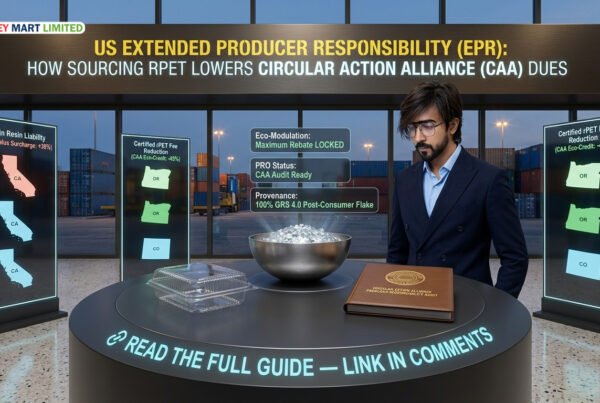
Eco-Modulation Fee Structures: Under eco-modulation, Producer Responsibility Organizations (PROs) penalize brands using virgin plastics with higher compliance fees while granting financial rebates to packaging engineered with certified, high-purity recycled content.
B. The Audit Hazard: Greenwashing Penalties
Regulators require third-party verification to prove that imported feedstock originates entirely from post-consumer collection rather than post-industrial off-spec scrap. Brands using unverified claims face severe regulatory audits, false-advertising litigation, and public greenwashing scandals.
Technical & Compliance Benchmark Table for EPR Sourcing
| Compliance & Technical Parameter | Uncertified Spot Material | Certified EPR-Compliant rPET Benchmark | Operational Impact on Brand Compliance |
| Traceability Standard | Unverified / Self-Declared | Global Recycled Standard (GRS 4.0) |
Provides legally binding audit trail for PRO reporting |
| PVC Contamination | $> 150 \text{ PPM}$ | < 25 – 50 PPM |
Prevents charring, black specks, and chain scission during extrusion |
| Moisture Content | Variable ($> 1.0\%$) | < 0.5% (Pre-Dryer Target) |
Prevents hydrolytic IV drop in preforms and sheet production |
| Flake Particle Uniformity | Irregular ($2 – 18 \text{ mm}$) | Uniform 8 – 12 mm |
Ensures stable melt pressure and prevents screw feeding surges |
| Heavy Metals & Contaminants | Unmonitored | Sub-10 PPM Heavy Metals (RoHS) |
Guarantees compliance with food-contact and toxicity standards |
2. Key Criteria for Sourcing Certified EPR-Compliant Feedstock
To fulfill statutory EPR obligations without risking line stoppage or regulatory rejection, procurement teams must enforce three non-negotiable sourcing parameters:
-
Mandatory Transaction Certificates (TC): Every shipment must be accompanied by an official Transaction Certificate issued by accredited certification bodies (e.g., Control Union), verifying the exact volume of 100% post-consumer material transferred from the exporter to the importer.
-
Sub-50 PPM Contaminant Purity: Feedstock must undergo advanced hot caustic washing and Near-Infrared (NIR) optical sorting to ensure PVC $< 50 \text{ PPM}$, protecting high-speed extrusion lines from chemical degradation.
-
High Density Container Loading: Maximizing container payload to 25–26 Metric Tons per 40ft High Cube container optimizes ocean transport logistics and lowers the carbon footprint per metric ton, aligning with Scope 3 corporate decarbonization targets.
Read More: A Step-by-Step Guide to Importing PET Flakes from Bangladesh via Chittagong Port
3. How Key Mart Limited Empowers Global Brands to Fulfill EPR Mandates
Securing statutory compliance under global EPR regulations requires a reliable, high-capacity manufacturing partner capable of delivering audited certification alongside uncompromised technical performance.
As a premier pet flakes company bangladesh and trusted pet flakes exporter, Key Mart Limited delivers certified, high-purity feedstock engineered for global brand compliance:
-
GRS 4.0 Certified Manufacturing in Dhaka: Operating as a leading pet flakes manufacturer dhaka, Key Mart Limited maintains full chain-of-custody tracking from post-consumer bottle collection to final export loading, providing GRS 4.0 Transaction Certificates (TCs) for flawless regulatory auditing.
-
Advanced Optical Sorting & Hot-Caustic Washing: As an established bangladesh pet flakes manufacturer, our facility subjects crushed bottles to continuous hot caustic washing ($85^\circ\text{C}-95^\circ\text{C}$) and high-resolution NIR sorting, guaranteeing PVC $< 50 \text{ PPM}$ and moisture $< 0.5\%$.
-
Uncompromising Quality Assurance: Serving as an experienced pet flakes exporter, Key Mart Limited provides batch-specific Certificates of Analysis (CoA) detailing Intrinsic Viscosity (IV), bulk density, color values, and moisture levels to ensure seamless integration into thermoforming, fiber spinning, and bottle preform lines.
-
Maximized 25–26 MT Payload Density: We pack 25–26 Metric Tons into every 40ft High Cube container using heavy-duty 100-micron PE inner liners to protect against transoceanic moisture during shipping under FOB Chittagong, CFR, or CIF terms.
Partner with Key Mart Limited Today
Fulfill your statutory EPR targets, secure GRS 4.0 audited supply chains, and import high-purity rPET flakes from Bangladesh. Contact our Dhaka export management team today to request Transaction Certificates, Technical Data Sheets, or reserve container allocation schedules.
-
Company Name: Key Mart Limited
-
Head Office & Factory Address: Plot #31, Road #N-1, Block #K, Eastern Housing, Pallabi 2nd Phase, Rupnagar, Dhaka-1216, Bangladesh.
-
Official Website: www.keymartbd.com
-
Corporate Email: keymartltd@gmail.com | info@keymartbd.com
-
Direct Phone / WhatsApp: +8801760774499, +8801864935478
Join our community today and stay connected with the future of PET recycling.
 Visit our YouTube channel: Key Mart Limited on YouTube
Visit our Facebook Page: Key Mart Limited on Facebook
Subscribe to see our latest factory tours, production updates, and export success stories.