Views: 15
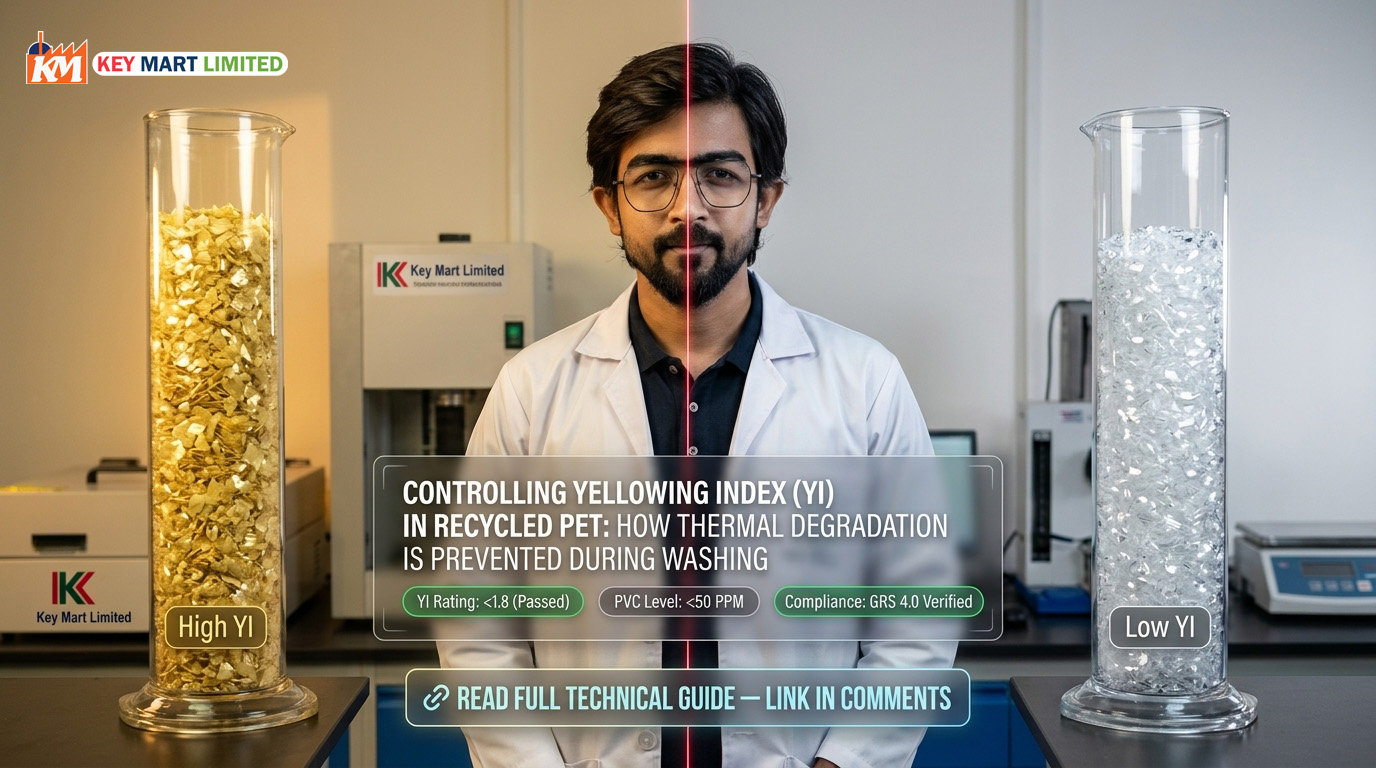
For global manufacturers producing high-end polyester staple fiber (PSF), strapping, and direct-to-sheet thermoforming, the visual clarity of recycled Polyethylene Terephthalate (pet flakes) is paramount. The single biggest threat to this clarity is a high Yellowing Index (YI). A slight yellow tint in the feedstock indicates invisible technical problems—specifically, thermal degradation of the polymer chain.
If your recycled flakes are already yellow when they reach your extruder, the heat of processing will only worsen the discoloration, leading to weak final products with poor tensile strength and unacceptable color consistency. In this technical article, we explore the precise relationship between washing and thermal degradation, and how advanced processing keeps YI low.
1. The Chemistry of Yellowing: Thermal Degradation vs. Purity
To control YI, we must first understand its root cause in the recycling process. Post-consumer PET bottles do not start yellow; the color is induced during processing.
What is Thermal Degradation?
Thermal degradation occurs when PET is exposed to excessive heat, oxygen, and certain contaminants simultaneously for an extended period. This triggers a chemical breakdown of the polymer chain, a process known as random chain scission. This breakdown results in the formation of acetaldehyde, shortened polymer chains (lower IV), and conjugated double bonds—the structures that visually absorb blue light and reflect yellow light.
In traditional recycling lines, this often happens because flakes are over-dried at too high a temperature or left in a washing step too long.
Contaminants Accelerate Thermal Damage
The presence of invisible contaminants—primarily residual labeling adhesives (glue), PVC residues, and alkaline cleaners—lowers the temperature at which PET begins to degrade. These contaminants act as catalysts, breaking down the polymer matrix faster and at lower temperatures, leading to a much higher YI score.
Thermal Exposure + Contaminants (PVC/Glue) ➔ Chain Scission ➔ High YI (Yellowing) + High Acetaldehyde
2. Preventing Thermal Degradation: The Advanced Washing Process
Achieving a Low YI (often targeted < 2.0) requires a holistic, multi-stage washing process designed to remove the primary degradation catalysts: PVC and Glue.
| Process Stage | Anti-Degradation Mechanism | Contaminant Removed |
| Near-Infrared (NIR) Sorting | Purest clear bottle feed, minimizing PVC. | PVC < 50 PPM |
| Hot Caustic Washing ($85^\circ\text{C}-95^\circ\text{C}$) | Intense chemical cleaning to lift tough glue. | Glue/Adhesive Residuals |
| Friction Washing & Elutriation | Mechanical scrubbing and air separation. | Label Residues & Fines |
| Final Dry Sizing & De-dusting | Controlled temperature drying to prevent heat stress. | Water & Electrostatic Dust |
By strictly maintaining a process window of $<50 \text{ PPM PVC}$, advanced wash lines can operate effectively at $90^\circ\text{C}$ without catalyzing the polymer breakdown.
Read More: A Step-by-Step Guide to Importing PET Flakes from Bangladesh via Chittagong Port
The Role of Optical Color Sorting
The final frontier in YI control is the multi-channel optical sorter. Even after advanced washing, a fraction of clear flakes may still have a subtle yellow or grey tint. The optical sorter uses high-resolution cameras and ultraviolet light to detect and physically eject these flakes, ensuring the final composite YI score is extremely low.
3. How Key Mart Limited Fulfills Global Buyer Demand
Achieving and maintaining certified Low YI feedstock requires an experienced manufacturing partner with sophisticated processing infrastructure.
As a premier pet flakes company bangladesh and trusted pet flakes exporter, Key Mart Limited is uniquely positioned to meet and exceed global buyer demands for visual clarity and chemical purity:
-
State-of-the-Art Dhaka Facility: Operating as a leading pet flakes manufacturer dhaka, our processing plant features multi-stage hot-caustic washing and NIR-guided automated optical color sorters. This integrated system systematically achieves the lowest YI scores in the region.
-
PVC and Glue Control: As an experienced pet flakes exporter, we understand that Low YI is impossible without low contaminants. Key Mart Limited guarantees feedstock with sub-50 PPM PVC limits, sub-500 PPM color contamination, and zero residual glues.
-
Technical Grade Certification: Serving as a high-volume pet flakes manufacturer dhaka, we provide full transparency. Every shipment includes a batch-specific Certificate of Analysis (CoA), verifying compliance with GRS 4.0 standards and Low YI benchmarks.
Partner with Key Mart Limited Today
Secure a consistent, Low Yellowing Index rPET supply chain, protect your manufacturing equipment, and ensure final product quality. Contact our Dhaka export management team to request Technical Data Sheets, order commercial samples, or reserve container allocation.
-
Company Name: Key Mart Limited
-
Head Office & Factory Address: Plot #31, Road #N-1, Block #K, Eastern Housing, Pallabi 2nd Phase, Rupnagar, Dhaka-1216, Bangladesh.
-
Official Website: www.keymartbd.com
-
Corporate Email: keymartltd@gmail.com | info@keymartbd.com
-
Direct Phone / WhatsApp: +8801760774499, +8801864935478
Join our community today and stay connected with the future of PET recycling.
👉 Visit our YouTube channel: Key Mart Limited on YouTube
👉 Visit our Facebook Page: Key Mart Limited on Facebook
Subscribe to see our latest factory tours, production updates, and export success stories.