Views: 5
For food packaging thermoformers and sheet converters, balancing raw material costs with strict regulatory compliance is an everyday challenge. With retailers and legislation demanding higher post-consumer recycled content in thermoformed clamshells, blister packs, and food trays, running 100% virgin resin is no longer economically or environmentally viable.
At the same time, using 100% mechanical recycled PET (pet flakes) for direct food-contact packaging introduces strict migration limits under EFSA and US FDA standards, alongside potential surface imperfections like minor optical haze or gel specks.
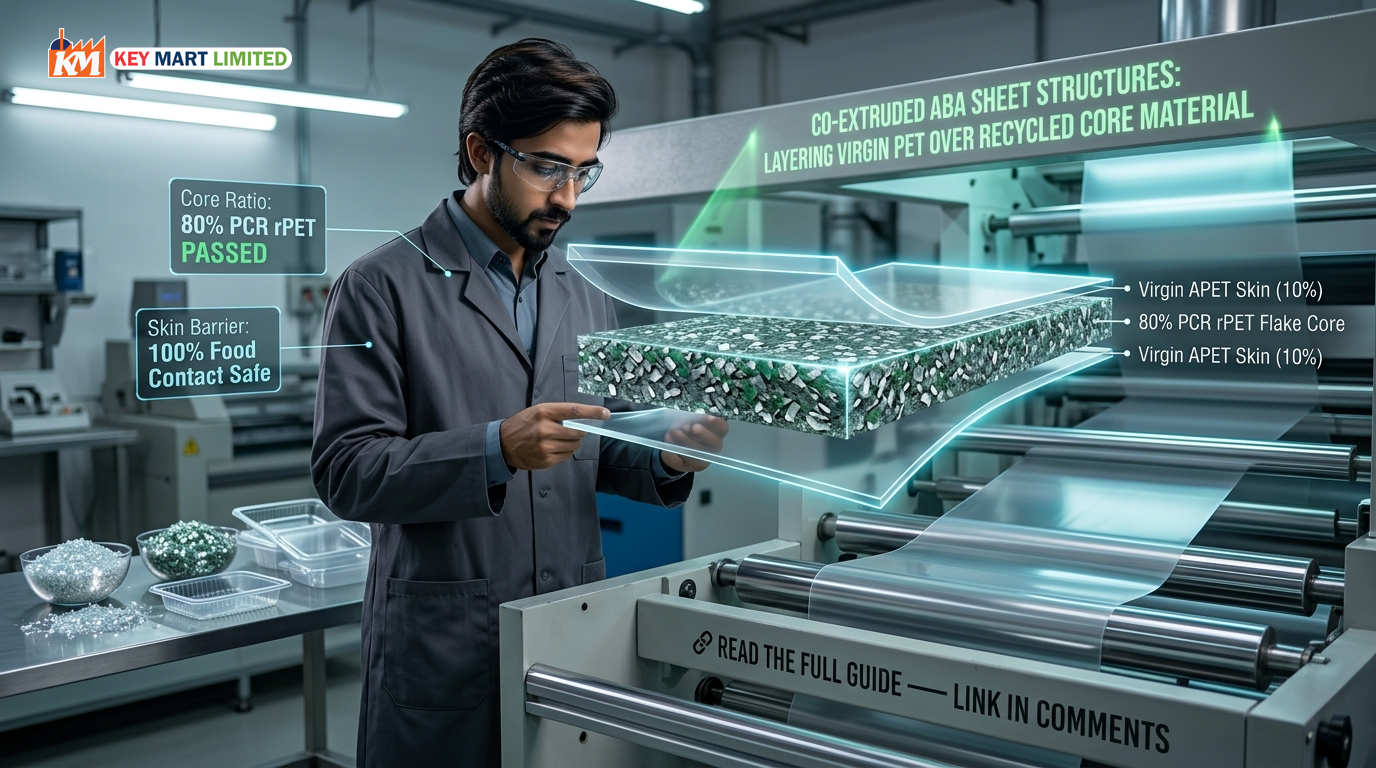
The industry-proven solution that bridges cost reduction, optical appeal, and food safety is ABA coextrusion rPET sheet technology.
By sandwiching a high-percentage recycled PET core (Layer B, up to 70%–80% of total sheet thickness) between two ultra-thin virgin APET skin layers (Layers A, roughly 10%–15% each), converters create an effective functional barrier.
This multi-layer architecture keeps virgin material where it matters most—at the direct food-contact surface—while using cost-effective, high-volume rPET flakes inside the core.
This technical converting guide explains the mechanics of multi-manifold ABA feedblocks, layer distribution ratios, and migration barrier dynamics, while illustrating how Key Mart Limited delivers the high-IV, low-contaminant rPET flakes needed for high-yield ABA sheet production.
1. Engineering the ABA Architecture: Mechanics and Layer Ratios
A standard 3-layer co-extrusion line utilizes two separate extruders feeding into a specialized co-extrusion feedblock and flat T-die:
Extruder A (Virgin APET Skins) ──┐
                                 ├─► ABA Multi-Manifold Feedblock ─► Flat T-Die ─► Mirror Chill Rolls ─► 3-Layer ABA Sheet
Extruder B (Recycled rPET Core) ─┘
A. The 10/80/10 Layer Ratio Distribution
-
Outer Skin Layers (A-Layers, 10%–15% each): Extruded from virgin APET to ensure flawless surface gloss, low seal initiation temperatures, and a certified functional barrier that prevents non-intentionally added substances (NIAS) from migrating toward food.
-
Core Layer (B-Layer, 70%–80%): Extruded from high-purity post-consumer pet flakes. This bulky center carries the recycled content mandate, drives down formulation costs, and provides structural stiffness.
B. Rheological Matching and Viscosity Pinning
Co-extruding two different polymer melt streams requires close Intrinsic Viscosity ($IV$) alignment. If the melt viscosity of the rPET core deviates significantly from the virgin outer skins ($\Delta IV > 0.08\text{ dL/g}$), shear-rate mismatches at the layer interfaces will cause:
-
Interfacial Wave Instability: Wavy, zig-zag optical distortions inside the transparent sheet.
-
Encapsulation Defects: The lower-viscosity melt wraps around the higher-viscosity melt at the die edges, causing uneven layer thickness across the web width.
Maintaining an incoming flake $IV$ of $0.78\text{ to }0.82\text{ dL/g}$ ensures the core matches the melt rheology of standard virgin APET ($0.80\text{ dL/g}$), preventing delamination and optical wave defects.
ABA Co-Extrusion vs. Monolayer Sheet Benchmark Table
Read More: A Step-by-Step Guide to Importing PET Flakes from Bangladesh via Chittagong Port
| Performance Parameter | 100% Virgin APET Monolayer | 100% Utility rPET Monolayer | Optimized ABA Sheet (Key Mart Core) |
| Total Recycled Content | $0\%$ (Fails sustainability mandates) | $100\%$ (High regulatory burden) | 70% – 80% PCR rPET Core (ABA) |
| Raw Material Cost Index | Baseline High ($100\%$) | Lowest ($60\%\text{–}65\%$) | Optimized Savings (70%–75% of Virgin) |
| Food-Contact Compliance | Direct Food Contact Approved | Strict Migration Challenges | Functional Barrier Compliant (EFSA/FDA) |
| Surface Gloss & Optical Clarity | Premium ($L^* > 88.0, \text{Haze} < 0.8\%$) | Moderate Haze ($> 2.5\%$) | High Clarity (Virgin Skin Finish) |
| Core Intrinsic Viscosity (IV) | N/A | Variable ($< 0.70\text{ dL/g}$) | 0.78 – 0.82 dL/g (Stable Match) |
| PVC Contamination Ceiling | $0\text{ PPM}$ | $> 150\text{–}300\text{ PPM}$ | < 25 – 50 PPM (Continuous Hot-Caustic) |
| Micro-Dust & Fines ($<500\,\mu\text{m}$) | N/A | $> 2.5\%$ (Extruder surging) | < 0.3% (Multi-Stage Air Elutriated) |
| Supply Traceability | Fossil Baseline | Unverified Scrap | GRS 4.0 Transaction Certified (TC) |
2. Preventing Delamination and Pinholes in ABA Thermoforming
Thermoforming multi-layer ABA sheets into deep-draw food trays requires three primary operational controls:
-
Eliminate Fine Dust & Gels from Core Feedstock: Airborne fines and un-melted gels in the recycled core layer cause localized stress concentrations. During thermoforming draw-down, these gels punch through the thin virgin skin, creating micro-pinholes that compromise barrier integrity.
-
Control Pre-Extrusion Core Moisture ($< 50\text{ PPM}$): Processing wet rPET flakes leads to hydrolytic chain scission in Extruder B. The resulting $IV$ drop causes the core melt to thin out rapidly, leading to layer thickness variations across the sheet profile.
-
Calibrate Feedblock Vane Angles: Adjusting internal feedblock geometry ensures equal velocity profiles at the merge point, preventing shear stress spikes that weaken inter-layer adhesion.
3. How Key Mart Limited Supplies Premium Core-Grade rPET Flakes
Running high-speed ABA co-extrusion lines without web tears or layer distortion requires sourcing from an established bangladesh pet flakes manufacturer that guarantees chemical purity and consistent viscosity.
As a premier pet flakes company bangladesh and trusted pet flakes exporter, Key Mart Limited delivers low-dust, high-IV rPET flakes engineered specifically for ABA core-layer extrusion:
-
Source-Segregated Sourcing in Dhaka: Operating as a leading pet flakes manufacturer dhaka, Key Mart Limited selectively processes 100% post-consumer clear beverage bottles, rejecting contaminated industrial scrap, colored packaging, and non-PET plastics at our collection gates.
-
Continuous Hot-Caustic Decontamination ($85^\circ\text{C}-95^\circ\text{C}$): As an established bangladesh pet flakes manufacturer, our facility subjects flakes to continuous caustic friction washing and automated NIR optical sorting, fully saponifying label glues and stripping organic residues to guarantee $\text{PVC} < 25\text{–}50\text{ PPM}$ and zero glue carryover.
-
Sub-0.3% Fines Removal via Air Elutriation: Serving as an experienced pet flakes exporter, Key Mart Limited passes every batch through automated multi-stage zig-zag air classifiers, keeping dust and fines strictly below $0.3\%$ to eliminate premature burning, gel formation, and core-layer pinholes.
-
Consistent IV Stability for Rheology Matching: Every export batch is tested in our Dhaka quality control laboratory for stable Intrinsic Viscosity ($0.78\text{–}0.82\text{ dL/g}$) and high luminance ($L^* \ge 74.0, b^* \le +1.2$), backed by batch-specific Certificates of Analysis (CoA) and Global Recycled Standard (GRS 4.0) Transaction Certificates (TC).
-
Maximized 25–26 MT Container Logistics: We pack 25–26 Metric Tons into every 40ft High Cube container with heavy-duty 100-micron PE inner liners to preserve feedstock dryness during transit under FOB Chittagong, CFR, or CIF shipping terms.
Partner with Key Mart Limited Today
Lower your sheet production costs, achieve up to 80% recycled content in thermoformed packaging, and secure high-purity rPET flakes from Bangladesh. Contact our Dhaka export management team today to request Technical Data Sheets, order commercial testing samples, or reserve monthly container allocations.
-
Company Name: Key Mart Limited
-
Head Office & Factory Address: Plot #31, Road #N-1, Block #K, Eastern Housing, Pallabi 2nd Phase, Rupnagar, Dhaka-1216, Bangladesh.
-
Official Website: www.keymartbd.com
-
Corporate Email: keymartltd@gmail.com | info@keymartbd.com
-
Direct Phone / WhatsApp: +8801760774499, +8801864935478
Join our community today and stay connected with the future of PET recycling.
 Visit our YouTube channel: Key Mart Limited on YouTube
Visit our Facebook Page: Key Mart Limited on Facebook
Subscribe to see our latest factory tours, production updates, and export success stories.