Views: 3
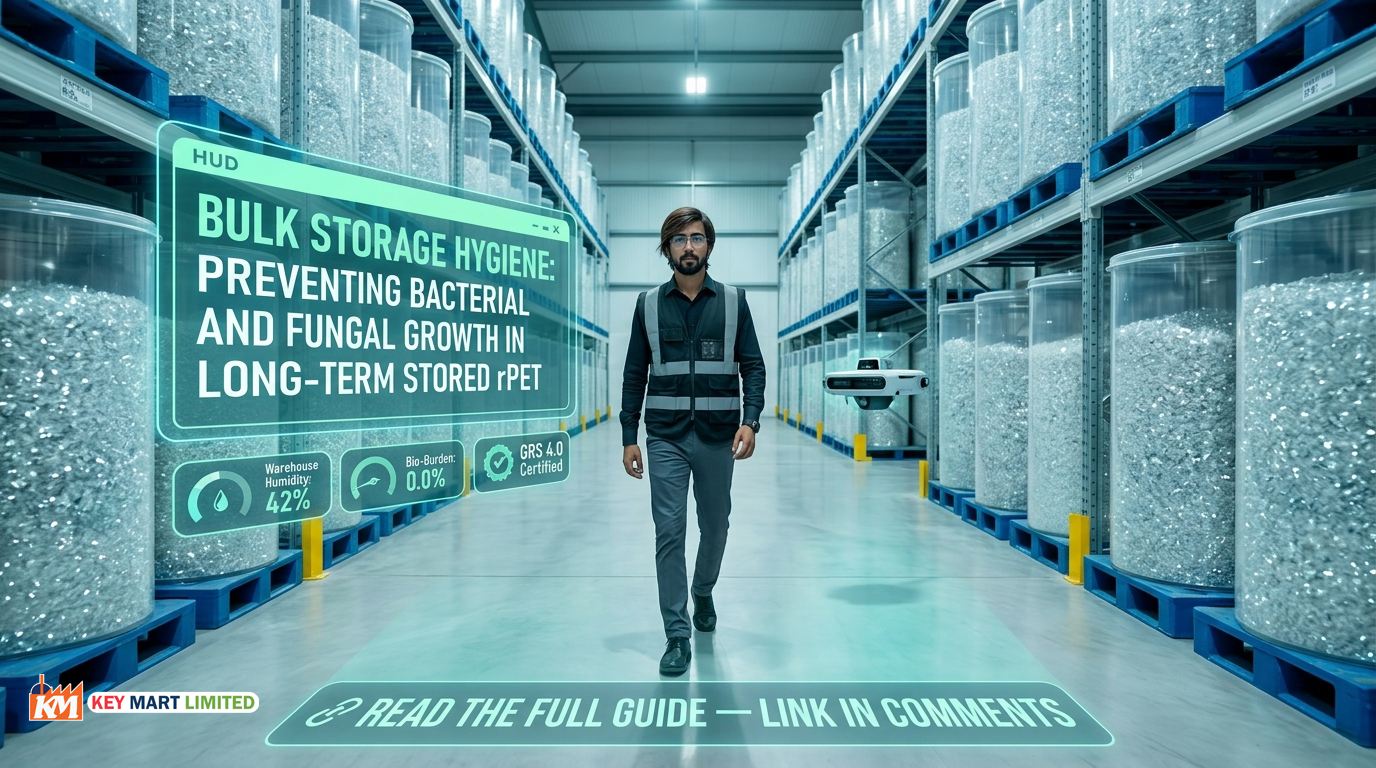
For continuous thermoforming operations, sheet extrusion plants, and synthetic fiber spinning mills, managing inventory through strategic bulk purchasing is essential for supply continuity. However, warehousing high volumes of post-consumer recycled Polyethylene Terephthalate (pet flakes) for extended periods exposes converters to a severe, often underestimated risk: biological contamination.
When post-consumer rPET flakes are stored in uncontrolled warehouse environments, lingering organic residues from beverage sugars, protein traces, and starch-based label glues act as nutrient sources for microorganisms.
Under high ambient humidity and temperature fluctuations, interstitial moisture condensation triggers rapid bacterial proliferation and fungal spore colonization.
This biological degradation creates foul odors, discoloration, severe foaming during drying, hydrolytic Intrinsic Viscosity (IV) loss, and black specks during extrusion.
Maintaining material integrity requires adhering to best practices for storing recycled PET flake bulk warehouse operations, integrating strict climate-control protocols, and sourcing thoroughly decontaminated feedstock.
This operational guide details the biological mechanisms of rPET spoilage, defines warehouse climate parameters, and illustrates how Key Mart Limited delivers biologically clean, dry rPET feedstock designed for long-term storage stability.
1. Biological Spoilage Mechanisms in Stored Recycled PET
Polyethylene Terephthalate is a synthetic polymer resistant to direct microbial digestion under normal storage conditions. However, post-consumer flakes are vulnerable through two distinct pathways:
Organic Residues + Trapped Moisture (>0.5%) + High Relative Humidity (>65% RH) ➔ Microbial Colonization ➔ Acidic Metabolite Secretion ➔ Hydrolytic Chain Scission & Discoloration
A. Microbial Biofilm Formation on Organic Substrates
If washing lines fail to fully eliminate beverage sugars (fructose, glucose), dairy proteins, and water-soluble label starches, these residues remain bound in micro-crevices on flake surfaces.
-
Fungi (Aspergillus, Penicillium) and aerobic bacteria colonize the flakes inside storage bags.
-
As microorganisms metabolize organic traces, they form sticky extracellular polymeric substances (EPS) or biofilms, causing flakes to agglomerate into solid clumps that jam silo discharge gates and pneumatic conveying lines.
B. Enzymatic and Acidic Hydrolysis
Microbial colonies secrete organic acids (such as acetic, lactic, and oxalic acids) and extracellular enzymes as metabolic byproducts. These acidic secretions catalyze the hydrolytic cleavage of PET ester bonds at room temperature over prolonged storage ($3\text{–}6\text{ months}$), permanently degrading the polymer’s base Intrinsic Viscosity ($IV$) before it ever reaches the dryer.
2. Warehouse Climate Control & Storage Architecture
To prevent bacterial proliferation and moisture re-absorption, bulk storage facilities must implement strict environmental controls:
Incoming Sealed Liners ➔ Off-Floor Pallet Staging ➔ Dehumidified Airflow (<50% RH, <25°C) ➔ Periodic VOC/Odor Auditing ➔ Zero Bio-Burden Feedstock
-
Relative Humidity (RH) and Temperature Ceilings: Warehouse storage zones should maintain a Relative Humidity below 50% and temperatures under $25^\circ\text{C}$. Ambient RH exceeding $65\%$ promotes rapid fungal spore germination within 48 to 72 hours.
-
Heavy-Duty Sealed Barrier Liners: Flakes should remain hermetically sealed inside thick (100-micron) Polyethylene (PE) inner liners inside multi-trip woven polypropylene FIBC jumbo bags or corrugated Octabins to block atmospheric moisture ingress.
-
Off-Floor Pallet Staging & Airflow Gaps: Store bags on plastic or treated heat-sanitized wooden pallets, elevated at least $15\text{ cm}$ off concrete floors and $50\text{ cm}$ away from external warehouse walls to prevent dew-point condensation caused by cold concrete interfaces.
-
First-In, First-Out (FIFO) Rotation: Enforce strict inventory tracking to limit open-warehouse exposure times and rotate stock systematically.
Read More: A Step-by-Step Guide to Importing PET Flakes from Bangladesh via Chittagong Port
Warehouse Bulk Storage Hygiene & Parameter Matrix
| Storage & Hygiene Parameter | Uncontrolled Scrap Storage | Standard Commercial Storage | Key Mart High-Hygiene Standard |
| Warehouse Relative Humidity (RH) | Uncontrolled ($>75\%\text{ RH}$) | $60\%\text{–}70\%\text{ RH}$ | < 45% – 50% RH (Dehumidified) |
| Storage Temperature Ceiling | Ambient ($>35^\circ\text{C}$ High Heat) | $28\circ\text{C}\text{–}32^\circ\text{C}$ | < 22°C – 25°C (Climate-Regulated) |
| Organic & Biological Residue | High (Beverage / Sugar traces) | Trace residues | 0.0% Bio-Burden (Hot-Caustic Saponified) |
| Residual Moisture at Sealing | $> 1.5\%$ (Wet Flakes) | $0.8\text{–}1.0\%$ | < 0.5% (Centrifugally & Heat Dried) |
| Packaging Barrier Protection | Unlined Single-Layer Bags | Standard 50-micron liner | Heavy-Duty 100-Micron Hermetic PE Liners |
| Bacterial/Fungal Odor Formation | Severe / Musty Smell | Moderate after 90 days | Zero Odor / Indefinite Shelf Stability |
| PVC Contamination | $> 150\text{–}300\text{ PPM}$ | $50\text{–}100\text{ PPM}$ | < 25 – 50 PPM (Continuous Hot-Caustic) |
| Supply Traceability & Audit | Unverified | Self-Declared | GRS 4.0 Transaction Certified (TC) |
3. How Key Mart Limited Guarantees Long-Term Storage Stability
Preventing biological growth during long ocean transit and long-term warehousing requires sourcing feedstock from an established bangladesh pet flakes manufacturer with institutional hot-wash sanitization and hermetic export packaging.
As a premier pet flakes company bangladesh and trusted pet flakes exporter, Key Mart Limited delivers biologically clean, dry rPET flakes engineered for extended warehouse shelf life:
-
Source-Segregated Clear Bottle Intake in Dhaka: Operating as a leading pet flakes manufacturer dhaka, Key Mart Limited exclusively processes 100% post-consumer clear beverage containers, rejecting mixed municipal solid waste, bio-hazardous scrap, and unwashed containers at collection gates.
-
Continuous Hot-Caustic Sterilization ($85^\circ\text{C}-95^\circ\text{C}$): As an established bangladesh pet flakes manufacturer, our facility subjects flakes to high-temperature caustic friction washing, fully saponifying label glues, stripping beverage sugars, and neutralizing 100% of organic bacterial and fungal spore loads.
-
Intensive Multi-Stage Fresh Water Rinsing & Heat Drying: Flakes pass through high-speed friction washers and counter-current fresh water stages, followed by centrifugal and thermal drying to lock final moisture strictly below 0.5%, eliminating the moisture needed for microbial growth.
-
Sub-0.3% Dust Removal via Air Elutriation: Serving as an experienced pet flakes exporter, Key Mart Limited extracts fines through multi-stage zig-zag classifiers, preventing dust from trapping humidity inside stored bags.
-
Hermetic Export Packaging (25–26 MT FCL): Every 40ft High Cube container is loaded with 25–26 Metric Tons packaged in heavy-duty woven bags lined with 100-micron virgin PE inner liners, preserving dryness and purity during ocean shipping under FOB Chittagong, CFR, or CIF terms.
Partner with Key Mart Limited Today
Eliminate warehouse spoilage, prevent fungal odor contamination, and secure shelf-stable, high-purity rPET flakes from Bangladesh. Contact our Dhaka export management team today to request Technical Data Sheets, order commercial testing samples, or reserve monthly container allocations.
-
Company Name: Key Mart Limited
-
Head Office & Factory Address: Plot #31, Road #N-1, Block #K, Eastern Housing, Pallabi 2nd Phase, Rupnagar, Dhaka-1216, Bangladesh.
-
Official Website: www.keymartbd.com
-
Corporate Email: keymartltd@gmail.com | info@keymartbd.com
-
Direct Phone / WhatsApp: +8801760774499, +8801864935478
Join our community today and stay connected with the future of PET recycling.
 Visit our YouTube channel: Key Mart Limited on YouTube
Visit our Facebook Page: Key Mart Limited on Facebook
Subscribe to see our latest factory tours, production updates, and export success stories.