Views: 7
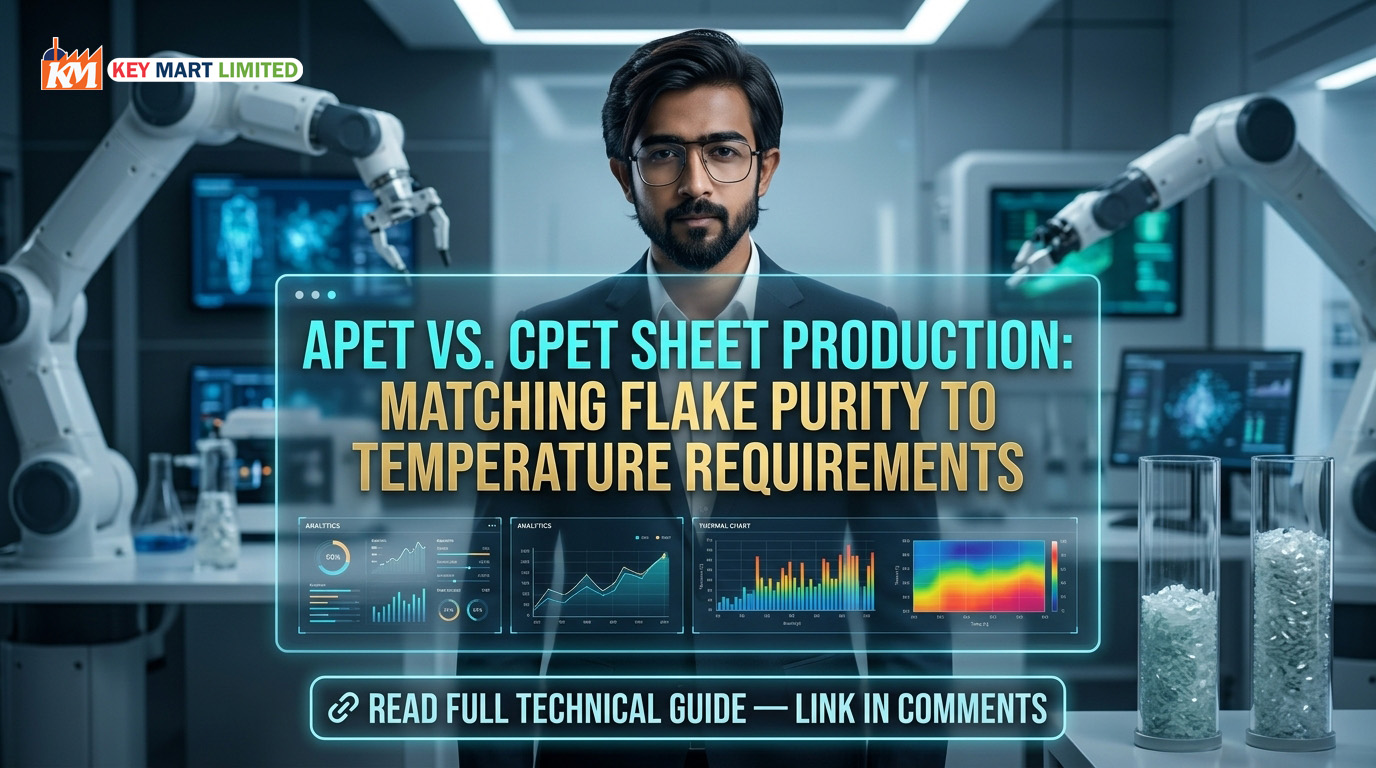
In the rigid packaging sector, thermoformed Polyethylene Terephthalate (PET) sheet extrusion is divided into two primary categories: Amorphous PET (APET) and Crystalline PET (CPET).
While both packaging materials rely on post-consumer recycled Polyethylene Terephthalate (pet flakes) as a primary feedstock, their operating thermal environments and end-use requirements are drastically different. APET is engineered for high-clarity, room-temperature/cold packaging (such as fruit punnets and blister packs), whereas CPET is designed for dual-ovenable food trays capable of handling temperatures from $-40^\circ\text{C}$ up to $+220^\circ\text{C}$.
For sheet extruders, achieving high-efficiency production without sheet brittleness, haze, or thermal degradation requires matching raw material flake purity directly to the temperature demands of the process.
1. APET vs. CPET: Processing Mechanisms and Purity Sensitivity
The fundamental difference between APET and CPET lies in their molecular arrangement and how they behave during heating and cooling.
APET Extrusion ➔ Rapid Quenching ➔ Amorphous State (High Clarity, -20°C to 60°C Limit)
CPET Extrusion ➔ Nucleating Agents + Heat Setting ➔ Semicrystalline State (High Heat Resistance, -40°C to 220°C)
A. APET Sheet Production (Amorphous Focus)
APET sheets are extruded and rapidly cooled on chill rolls to prevent the polymer chains from crystallizing. This creates a clear, transparent structure.
-
Primary Flake Requirement: Low Yellowing Index (YI) and zero optical defects.
-
Sensitivity: Any particulate contaminant (like fine metal dust, ash, or paper fibers) acts as an unwanted nucleating site, causing localized micro-crystallization (haze/cloudiness) in an otherwise crystal-clear APET sheet.
B. CPET Sheet Production (Crystalline Focus)
CPET sheets undergo controlled heat-setting during thermoforming, often combined with nucleating agents (such as masterbatches or micro-talc), achieving $28\% – 32\%$ crystallinity. This crystalline matrix allows the tray to withstand dual-oven temperatures ($220^\circ\text{C}$).
-
Primary Flake Requirement: High thermal stability and ultra-low chemical contamination (PVC and glues).
-
Sensitivity: Because CPET packaging is exposed to high oven temperatures, any residual PVC, glue, or polyolefin in the feedstock will char, off-gas, or catalyze thermal degradation, causing severe tray embrittlement, odor issues, and structural failure under oven heat.
Technical Feedstock Requirement Matrix for Sheet Extrusion
| Chemical & Physical Parameter | APET Sheet Feedstock Target | CPET Sheet Feedstock Target | Technical Impact on Sheet Line |
| Intrinsic Viscosity (IV) | $0.70 – 0.76 \text{ dL/g}$ | ≥ 0.78 – 0.84 dL/g |
High IV prevents tray sagging in high-heat ovens |
| PVC Contamination | $< 50 \text{ PPM}$ | < 25 PPM |
Prevents black specks (APET) and thermal charring (CPET) |
| Polyolefin (Cap & Label) | $< 50 \text{ PPM}$ | < 25 PPM |
Eliminates haze (APET) and pinholes/weak spots (CPET) |
| Flake Sizing Range | Uniform $8 – 12 \text{ mm}$ | Uniform $8 – 12 \text{ mm}$ | Stabilizes extruder melt pressure & prevents gauge variation |
| Moisture Content | $< 0.5\%$ | < 0.3% |
Eliminates hydrolytic chain scission during extrusion |
2. Purity Benchmarks: Why Contaminant Limits Are Non-Negotiable
Whether manufacturing clear APET punnets or ovenable CPET trays, three key contaminants disrupt process stability:
-
PVC Inclusions ($>25-50 \text{ PPM}$): PVC degrades at $180^\circ\text{C}$, releasing hydrochloric acid ($\text{HCl}$) gas. In APET, this produces unsightly black carbon specks. In CPET, the acid accelerates PET chain scission, severely reducing impact resistance at freezing temperatures ($-40^\circ\text{C}$).
-
Residual Adhesives & Glues: Unwashed bottle-label adhesives turn yellow or brown during sheet extrusion. In APET, this ruins aesthetic transparency. In CPET, volatile organic compounds (VOCs) from burnt glue pollute the oven space during food heating.
-
Inconsistent Particle Size Distribution: Mixing fine dust ($<500\,\mu\text{m}$) with large flakes leads to erratic melting in the extruder screw, causing pressure spikes and sheet thickness variations.
Read More: A Step-by-Step Guide to Importing PET Flakes from Bangladesh via Chittagong Port
3. How Key Mart Limited Fulfills Buyer Demand for APET & CPET Feedstock
Meeting the rigorous specifications for APET transparency and CPET thermal stability requires an experienced, quality-driven raw material supplier.
As a premier pet flakes company bangladesh and trusted pet flakes exporter, Key Mart Limited supplies engineered, hot-washed feedstock designed specifically for sheet extrusion lines:
-
Advanced Processing in Dhaka: Operating as a leading pet flakes manufacturer dhaka, Key Mart Limited utilizes multi-stage friction washing, hot caustic washing ($85^\circ\text{C}-95^\circ\text{C}$), and automated NIR optical sorters to consistently achieve PVC levels below $25 – 50 \text{ PPM}$.
-
Optical Clarity for APET: As an established bangladesh pet flakes manufacturer, we employ multi-stage air elutriation and de-dusting systems to remove fine particulates, electrostatic dust, and polyolefin fragments—ensuring cloud-free transparency in clear APET sheet production.
-
High-IV Selection for CPET: Serving as an experienced pet flakes exporter, Key Mart Limited selectively sources carbonated soft drink bottle streams to supply feedstock with high inherent IV ($0.78 – 0.82 \text{ dL/g}$), giving CPET trays the structural integrity needed to endure dual-oven thermal stress.
-
Global Shipping & Certification: Every batch is backed by a Certificate of Analysis (CoA) confirming IV values, moisture levels, and Global Recycled Standard (GRS 4.0) compliance. Materials are packed in moisture-protected Baffle FIBC jumbo bags loading 25–26 Metric Tons per 40ft High Cube container under FOB Chittagong or CFR/CIF terms.
Partner with Key Mart Limited Today
Eliminate sheet haze, prevent thermal degradation in CPET trays, and secure high-purity rPET flakes tailored for your extrusion lines. Contact our Dhaka export management team today to request Technical Data Sheets, order commercial samples, or reserve container allocation schedules.
-
Company Name: Key Mart Limited
-
Head Office & Factory Address: Plot #31, Road #N-1, Block #K, Eastern Housing, Pallabi 2nd Phase, Rupnagar, Dhaka-1216, Bangladesh.
-
Official Website: www.keymartbd.com
-
Corporate Email: keymartltd@gmail.com | info@keymartbd.com
-
Direct Phone / WhatsApp: +8801760774499, +8801864935478
Join our community today and stay connected with the future of PET recycling.
👉 Visit our YouTube channel: Key Mart Limited on YouTube
👉 Visit our Facebook Page: Key Mart Limited on Facebook
Subscribe to see our latest factory tours, production updates, and export success stories.